 4.9 (349 Reviews)
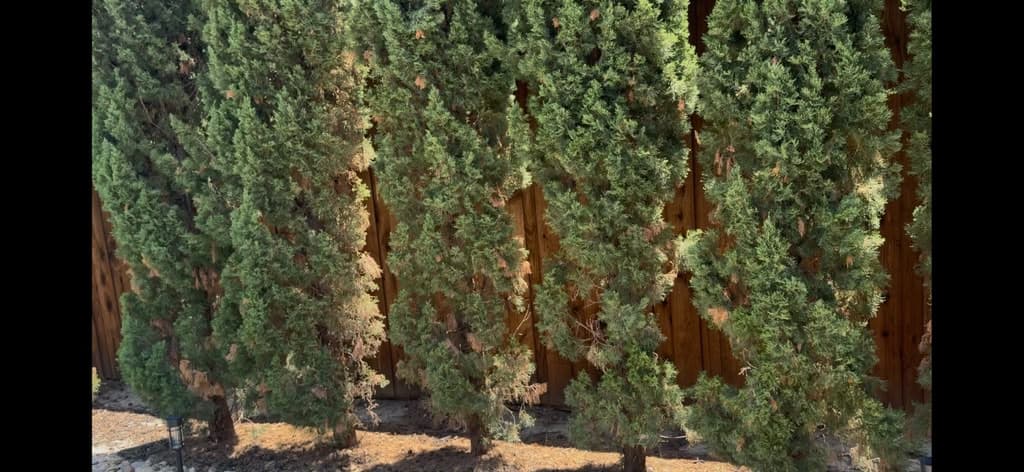
Italian Cypress (Cupressus sempervirens) are among the most elegant and recognizable trees found throughout high-end landscapes in Southlake. Their narrow upright form makes them a favorite for estate entrances, privacy screens, Mediterranean-style landscapes, and architectural focal points.
Unfortunately, Italian Cypress are also highly susceptible to one of the most destructive fungal diseases affecting conifer species throughout Texas:
Seiridium Canker
At Arborist USA, we are seeing a significant increase in Seiridium canker throughout Southlake, Westlake, Colleyville, Keller, and surrounding North Texas communities. In nearly every case, the fungal pathogen is only part of the problem.
The real issue often begins below ground.
During a recent Southlake inspection, we identified multiple Italian Cypress exhibiting:
- Browning canopy sections
- Sparse foliage density
- Progressive defoliation
- Necrotic branch tips
- Active Seiridium canker lesions
- Spider mite infestations
- Root-zone stress
- Soil moisture imbalance
The important takeaway is this:
The fungus is usually not the original problem.
The environmental stress comes first.
The fungal disease follows.
Understanding the relationship between root health, soil drainage, spider mite pressure, and fungal infection is critical for preserving Italian Cypress in North Texas landscapes.
What Is Seiridium Canker?
Seiridium canker is a fungal disease primarily affecting members of the cypress family.
The disease is commonly associated with:
- Seiridium cardinale
- Seiridium unicorne
- Seiridium cupressi
These fungi attack bark tissue, vascular tissue, twigs, branches, and scaffold structures.
According to arboricultural research, Seiridium is generally considered an opportunistic pathogen.
That means it typically colonizes trees that are already under stress.
Healthy vigorous trees can often resist infection.
Stressed trees become vulnerable.
Why Italian Cypress Are Vulnerable in Southlake
Italian Cypress evolved in environments characterized by:
- Excellent drainage
- Dry summers
- Aerated soils
- Limited standing water
- Moderate humidity
North Texas presents a different challenge.
Many landscapes experience:
- Clay-heavy soils
- Irrigation oversaturation
- Compaction
- Seasonal flooding
- Extended rainfall periods
These conditions create an environment where root stress develops rapidly.
Once root systems become stressed, susceptibility to fungal infection increases significantly.
The Role of Proper Drainage
One of the most important factors affecting Italian Cypress health is drainage.
Italian Cypress perform best in soils that allow:
- Oxygen exchange
- Water movement
- Root respiration
- Healthy microbial activity
When soils remain saturated for extended periods:
- Oxygen levels decline
- Root respiration decreases
- Root vigor weakens
- Nutrient uptake slows
- Stress hormones increase
This condition is known as:
Root-Zone Hypoxia
Understanding Root-Zone Hypoxia
Root-zone hypoxia occurs when oxygen availability becomes insufficient for normal root function.
Roots require oxygen to:
- Absorb nutrients
- Transport water
- Produce energy
- Maintain vascular health
Without oxygen:
- Fine feeder roots decline
- Nutrient deficiencies develop
- Carbohydrate production decreases
- Disease susceptibility increases
ISA research consistently identifies root-zone hypoxia as a major contributor to tree decline.
In Italian Cypress, the effects can be severe because of the way conifers transport water.
Why Conifers Are Sensitive to Oversaturation
Italian Cypress are conifers.
Unlike hardwoods, which rely heavily on vessel elements, conifers transport water primarily through structures known as:
Tracheids
Tracheids are:
- Narrower water-conducting cells
- More sensitive to environmental stress
- Less tolerant of oxygen deprivation
When soils become saturated:
- Water movement slows
- Oxygen declines
- Tracheid function decreases
This creates internal physiological stress that weakens the tree and makes fungal colonization easier.
Why Rainy Seasons Can Increase Disease Pressure
One of the biggest mistakes homeowners make is continuing irrigation during prolonged rainy periods.
During rainy seasons:
- Soil moisture accumulates
- Oxygen levels decline
- Root stress increases
- Fungal activity accelerates
Proper irrigation management is critical.
In many situations, irrigation should be reduced or temporarily shut off when natural rainfall provides sufficient moisture.
The objective is maintaining balance.
Too little water creates drought stress.
Too much water creates hypoxia.
Both conditions increase disease susceptibility.
Soil pH and Italian Cypress Health
Soil chemistry also plays an important role.
Excessive irrigation and poor drainage can influence nutrient availability and soil conditions.
Monitoring soil pH helps determine:
- Nutrient availability
- Iron uptake
- Manganese availability
- Root function efficiency
When pH becomes unfavorable:
- Nutrient deficiencies increase
- Chlorosis develops
- Root vigor declines
Proper soil testing and monitoring should be part of any comprehensive plant healthcare program.
Why Herbicides Around Italian Cypress Can Be Problematic
Another issue frequently observed in declining landscapes is herbicide use around the root zone.
Many homeowners and landscape crews apply herbicides near tree bases to eliminate weeds and grass competition.
Improper herbicide applications can:
- Stress feeder roots
- Disrupt soil biology
- Damage beneficial microorganisms
- Reduce root vigor
Already stressed trees become even more vulnerable to Seiridium infection.
Whenever possible, herbicide exposure around Italian Cypress should be minimized.
Spider Mites and Their Role in Decline
During our Southlake inspection, we also positively identified significant spider mite activity.
Spider mites are one of the most destructive secondary stress factors affecting Italian Cypress.
These pests feed by piercing foliage tissue and extracting cellular contents.
Over time they cause:
- Chlorophyll loss
- Needle bronzing
- Foliage discoloration
- Reduced photosynthesis
- Premature defoliation
The Science Behind Spider Mite Damage
Photosynthesis is how trees produce carbohydrates.
Carbohydrates fuel:
- Root growth
- Defense systems
- Vascular repair
- New foliage production
When spider mites remove chlorophyll:
- Photosynthesis decreases
- Carbohydrate reserves decline
- Stress tolerance weakens
This creates a vicious cycle.
The tree becomes weaker.
The fungus becomes stronger.
Why Seiridium and Spider Mites Are Often Found Together
One of the most common field observations is finding both conditions simultaneously.
The sequence often looks like this:
- Soil stress develops
- Root vigor declines
- Spider mites attack
- Photosynthesis decreases
- Carbohydrate reserves drop
- Seiridium colonizes stressed tissue
- Cankers expand
- Defoliation accelerates
- Structural decline increases
Together these problems can eventually lead to:
Postmortem decline
if intervention is delayed.
How Seiridium Canker Spreads
Seiridium spreads differently than oak wilt.
It does not primarily spread through root grafts.
Instead, transmission commonly occurs through:
- Airborne spores
- Wind movement
- Rain splash dispersal
- Contaminated pruning tools
- Infected branch tissue
During rainfall events, spores can move through:
- Canopy drip lines
- Foliage runoff
- Branch-to-branch contact
This is why disease management must focus on the entire canopy rather than isolated branches.
Why Antifungal Treatments Matter
Fungicidal applications remain an important part of management.
The objective is:
- Reduce fungal pressure
- Protect healthy tissue
- Slow canker expansion
- Preserve remaining foliage
Proper timing is critical.
Applications are generally most effective when disease pressure is identified early.
Integrated Pest Management (IPM)
A complete treatment plan should include Integrated Pest Management.
IPM addresses:
- Spider mites
- Secondary insects
- Environmental stressors
- Monitoring protocols
The goal is reducing overall stress rather than focusing on a single issue.
Soil Management and Long-Term Recovery
Long-term success requires correcting the environmental conditions that initiated decline.
This includes:
- Improving drainage
- Reducing oversaturation
- Monitoring pH
- Managing irrigation schedules
- Supporting soil biology
- Encouraging healthy root development
Healthy roots create healthy canopies.
Healthy canopies resist disease.
Our Recommended Treatment Protocol
For declining Italian Cypress in Southlake, our treatment strategy typically includes:
- Antifungal applications
- Spider mite management through IPM
- Soil moisture evaluation
- Drainage correction
- Soil pH monitoring
- Irrigation adjustments
- Micronutrient support
- Root-zone management
- Ongoing monitoring
The goal is not simply treating a fungus.
The goal is restoring the tree’s ability to defend itself.
Why Early Intervention Matters
Once severe cankers become established:
- Vascular disruption increases
- Branch mortality accelerates
- Canopy density declines
- Recovery becomes more difficult
Early diagnosis dramatically improves preservation potential.
The sooner environmental stress is corrected, the better the long-term outcome.
Final Thoughts
This Southlake project demonstrates a critical principle of modern arboriculture:
Seiridium canker is often a symptom of stress rather than the original cause of decline.
The underlying issues frequently include:
- Poor drainage
- Oversaturation
- Root-zone hypoxia
- Spider mite infestations
- Soil chemistry imbalance
- Environmental stress
By combining:
- Antifungal treatments
- IPM programs
- Proper irrigation management
- Soil monitoring
- Root-zone correction
Italian Cypress can often be stabilized before severe decline occurs.
At Arborist USA, our objective is not simply treating symptoms.
Our objective is identifying the environmental trigger, correcting the underlying problem, and preserving valuable landscape trees through TCIA, and science-based plant healthcare practices.
For general tree-care best practices, homeowners can also reference guidance from the Texas A&M Forest Service, https://tfsweb.tamu.edu/trees/, a trusted authority on Texas tree health.
Schedule a professional inspection. Early detection and scientific intervention are the difference between preservation and loss. If you’d like to speak to an arborist, please call us at 817-880-6130 or visit https://www.arboristusa.com/