 4.9 (349 Reviews)
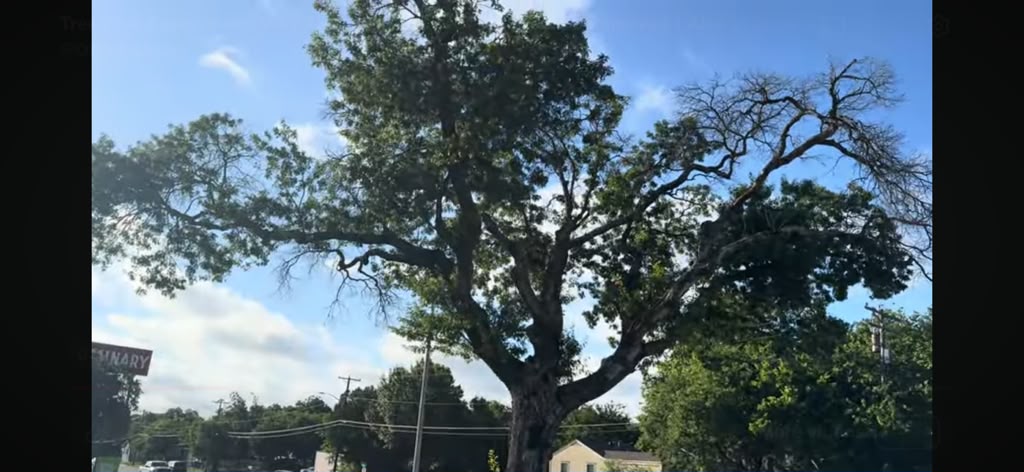
Large mature trees are among the most valuable assets in any landscape. They provide shade, environmental benefits, wildlife habitat, stormwater reduction, and significant property value. However, there comes a point when a tree’s structural defects outweigh the benefits of preservation.
In the historic Alta Vista neighborhood of Fort Worth, Arborist USA was recently called out to perform a comprehensive Tree Risk Assessment on a mature Shumard Red Oak (Quercus shumardii) exhibiting advanced structural decline, basal trunk deterioration, failed compartmentalization, severe sunscald damage, and active retrenchment.
After a detailed evaluation utilizing ANSI A300 standards, and modern arboricultural science, it became clear that this tree no longer represents an acceptable level of risk for the surrounding environment.
The recommendation for this tree is complete removal and stump grinding.
The reason is not simply because the tree is declining.
The reason is because the probability of failure, combined with the severity of the impact zone, creates an unacceptable hazard to pedestrians, motorists, and surrounding property.
What Is a Tree Risk Assessment?
One of the biggest misconceptions homeowners have is believing arborists simply look at a tree and decide whether it should stay or be removed.
Professional tree risk assessment is a structured process.
According to the International Society of Arboriculture (ISA), risk is evaluated using three major components:
- Likelihood of Failure
- Likelihood of Impact
- Consequences of Failure
A tree may have substantial defects but represent minimal risk if there are no targets nearby.
Conversely, a tree with moderate defects can become a serious liability if positioned over:
- Homes
- Streets
- Sidewalks
- Utility lines
- Playgrounds
- Parking lots
- High-traffic pedestrian areas
This Shumard Red Oak falls directly into the second category.
Understanding Retrenchment in Mature Trees
One of the most significant observations during this assessment was evidence of natural retrenchment.
Retrenchment is a survival mechanism utilized by mature and aging trees.
In simple terms, the tree begins reducing the size of its canopy in an attempt to match declining structural and physiological capacity.
ISA research has documented retrenchment as a natural response to:
- Advanced age
- Root decline
- Structural defects
- Internal decay
- Environmental stress
- Reduced energy reserves
The tree essentially begins sacrificing portions of the canopy to preserve remaining resources.
Signs of Retrenchment
Common indicators include:
- Progressive canopy reduction
- Dead upper scaffold limbs
- Shortened branch growth
- Increased epicormic growth
- Dead branch tips
- Reduced foliage density
Retrenchment itself is not always a reason for removal.
Many ancient trees retrench and remain standing for decades.
However, retrenchment becomes problematic when combined with severe structural defects and high-value targets.
That is exactly what we observed on this tree.
The Importance of Structural Integrity
Trees survive because their structural support system remains intact.
That support system includes:
- Root flare
- Buttress roots
- Trunk wood
- Scaffold branches
- Branch attachments
When decay compromises these systems, mechanical strength decreases.
The concern is not whether the tree is alive.
The concern is whether the tree remains structurally capable of supporting itself.
Extensive Basal Rot
One of the most serious defects identified during this assessment was advanced basal rot.
The lower trunk region is one of the most critical load-bearing components of the tree.
This area transfers:
- Wind loads
- Canopy weight
- Dynamic movement forces
- Mechanical stress
into the root system.
Once decay becomes established in this region, the risk of catastrophic failure increases dramatically.
Sunscald Damage Accelerating Failure
The basal decay has been further complicated by severe sunscald injury.
Sunscald occurs when bark tissues experience excessive solar heating and thermal stress.
Over time, this leads to:
- Bark separation
- Deep cracking
- Cambial death
- Moisture intrusion
- Fungal colonization
On this Shumard Red Oak, the damage is not superficial.
The cracking extends deeply into the xylem tissue.
This is significant because xylem serves both physiological and structural functions.
When xylem integrity becomes compromised:
- Water transport declines
- Structural strength declines
- Decay expansion accelerates
The exposed area has become a major point of weakness within the trunk.
Understanding CODIT Failure
Trees defend themselves against decay through a process known as:
Compartmentalization Of Decay In Trees (CODIT)
Developed by Dr. Alex Shigo, CODIT explains how trees isolate injury and decay.
Trees create four defense barriers:
Wall 1
Wall 2
Wall 3
Wall 4
These walls attempt to restrict fungal movement within the wood.
What Happens When CODIT Fails?
When compartmentalization fails:
- Decay spreads vertically
- Decay spreads laterally
- Structural wood deteriorates
- Load-bearing capacity decreases
During this assessment, evidence strongly indicates that compartmentalization has largely failed.
The decay is no longer effectively contained.
Internal deterioration continues advancing throughout the trunk structure.
This dramatically reduces confidence in the tree’s long-term structural stability.
Why the Lean Increases Risk
Another critical factor is the tree’s orientation toward the roadway.
The canopy exhibits substantial lateral loading toward the street.
This creates increased torque on:
- The trunk
- The root flare
- The buttress roots
- The decayed basal area
The concern is not merely the lean itself.
The concern is a lean occurring on top of advanced structural defects.
This creates a mechanical disadvantage that increases loading on already compromised tissue.
Evaluating the Impact Zone
Risk assessment does not stop with the tree.
We must evaluate what the tree could strike if failure occurs.
This is referred to as the impact zone.
The impact zone for this tree includes:
Public Roadway
Several large scaffold limbs extend directly over a high-traffic street.
Failure could result in:
- Vehicle impact
- Loss of vehicle control
- Multi-vehicle accidents
- Injury or fatality
Pedestrian Traffic
Alta Vista is a highly active neighborhood.
The pedestrian occupancy rate is significant.
Failure could impact:
- Walkers
- Joggers
- Cyclists
- Families
Residential Structures
The canopy also influences nearby property and infrastructure.
Potential outcomes include:
- Property damage
- Roof impact
- Structural damage
Likelihood of Failure
Based upon the observed defects, my professional assessment places the likelihood of failure as:
High
Several factors contribute to this conclusion:
- Advanced basal decay
- Deep xylem cracking
- Failed compartmentalization
- Active retrenchment
- Structural loading toward the roadway
- Ongoing deterioration
Although exact timing of failure cannot be predicted, the probability of future structural failure is elevated beyond acceptable levels.
Consequences of Failure
The consequence rating is severe.
Why?
Because the impact zone contains:
- Vehicular traffic
- Pedestrian traffic
- Residential structures
A failure event involving one of the larger scaffold limbs or trunk sections could result in:
- Major vehicle accidents
- Severe injuries
- Fatalities
- Property damage
Tree risk is always a combination of probability and consequence.
In this case, both categories score high enough to warrant removal.
Why Pruning Is Not the Solution
One question homeowners frequently ask is:
“Can we just trim it?”
In this case, pruning would not adequately address the primary defects.
Pruning may reduce canopy weight temporarily.
However, pruning cannot correct:
- Internal decay
- Failed compartmentalization
- Basal rot
- Deep xylem cracking
- Structural instability
The defect exists within the trunk itself.
Reducing branches does not restore structural wood.
Why Removal Is Recommended
Arborists generally prefer preservation whenever practical.
However, public safety must remain the priority.
This recommendation is based upon:
- Structural defects
- Failure probability
- Target occupancy
- Consequence severity
The goal is proactive mitigation before a catastrophic event occurs.
Waiting until visible collapse begins often removes the opportunity for safe, controlled management.
Stump Grinding Considerations
Following removal, stump grinding is recommended.
Benefits include:
- Improved aesthetics
- Elimination of trip hazards
- Easier landscape restoration
- Prevention of sprouting
- Improved site usability
Complete removal allows the property owner to safely re-establish future landscape improvements.
Why Professional Risk Assessments Matter
Many trees appear healthy from a distance.
Green foliage does not automatically equal structural safety.
Some of the most dangerous trees in urban environments still retain leaves and partial canopy density.
The defects exist internally.
Final Thoughts
This Shumard Red Oak in Alta Vista, Fort Worth demonstrates how structural decline can progress beyond the point where preservation remains practical.
The combination of:
- Advanced retrenchment
- Extensive basal rot
- Deep xylem cracking
- Severe sunscald damage
- Failed CODIT response
- Heavy roadway exposure
- High pedestrian occupancy
creates an unacceptable risk profile.
Although mature trees provide tremendous value, the responsibility of a consulting arborist is to objectively evaluate risk and recommend the safest course of action.
In this case, complete removal and stump grinding represent the most responsible long-term solution.
At Arborist USA, our goal is not simply removing trees.
Our goal is protecting people, preserving property, and providing science-based recommendations using ANSI A300 standards, TCIA best practices, and modern arboricultural science.
For general tree-care best practices, homeowners can also reference guidance from the Texas A&M Forest Service, https://tfsweb.tamu.edu/trees/, a trusted authority on Texas tree health.
Schedule a professional inspection. Early detection and scientific intervention are the difference between preservation and loss. If you’d like to speak to an arborist, please call us at 817-880-6130 or visit https://www.arboristusa.com/