 4.9 (349 Reviews)
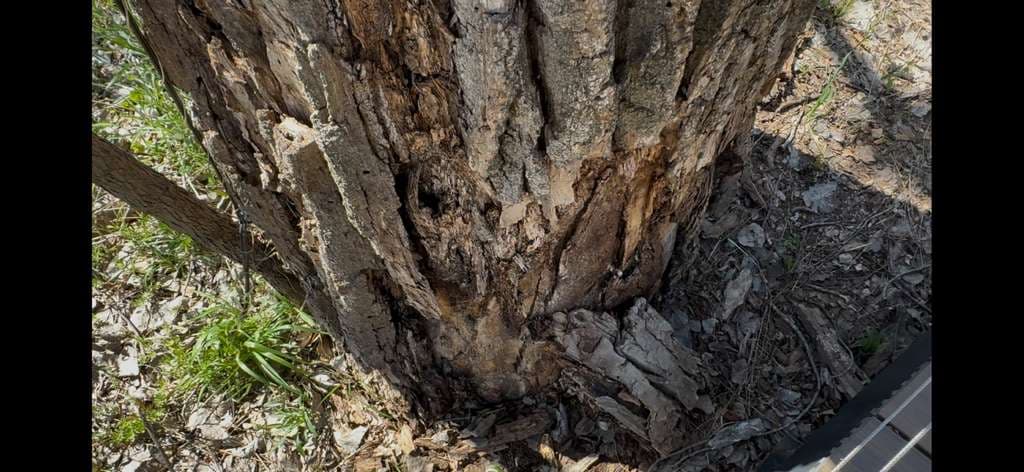
In Granbury, Texas, especially along high-use recreational corridors such as the Brazos River, tree risk assessments must account not only for structural defects but also for active pest pressure that can compromise long-term stability.
This assessment focuses on a mature cottonwood (Populus deltoides) currently under significant attack from cottonwood borer beetles, resulting in visible basal damage, internal wood degradation, and early-stage structural compromise.
Due to the high pedestrian traffic in this area, the tree represents a developing risk that must be addressed immediately through an Integrated Pest Management (IPM) and plant health care (PHC) program.
Observed Symptoms and Site Conditions
During the inspection, several key indicators of cottonwood borer activity and structural concern were identified at the base of the tree.
A large basal wound was observed at the root flare, measuring approximately 15 inches by 15 inches. This wound has resulted in bark displacement and exposed internal wood tissue.
Within this exposed area, extensive wood galleries are visible. These galleries are created by larval feeding activity of the cottonwood borer (Plectrodera scalator), a known destructive pest of cottonwood species.
Additional observations include:
• Multiple “pinhole” exit and entry points along the trunk, indicating active infestation
• Tunneling within the xylem tissue, reducing structural integrity
• A superficial vertical crack extending approximately 1 to 2 inches into the xylem
• Location within a high pedestrian recreational zone along the Brazos River
While the crack appears superficial at this time, the underlying concern is the cumulative internal damage caused by borer activity.
Understanding Cottonwood Borer Damage
The cottonwood borer is a longhorn beetle species that targets weakened or stressed cottonwood trees. The adult beetles lay eggs in bark crevices, particularly near wounds or damaged tissue.
Once hatched, larvae bore into the tree and begin feeding on the cambium and xylem layers.
This feeding behavior creates:
• Tunnels (galleries) within the wood
• Disruption of vascular transport (water and nutrient movement)
• Structural weakening due to loss of wood fiber integrity
According to research from Texas A&M AgriLife Extension, repeated infestations can lead to extensive internal hollowing of the trunk over time.
This is the primary concern with cottonwood borer pressure—not just surface damage, but internal degradation that is not always visible externally.
Tree Physiology and Structural Risk
Trees rely on intact xylem tissue to provide both vascular transport and mechanical support. The strength of a tree is directly tied to the integrity of its cellulose and lignin structure.
As borer larvae consume wood tissue, they compromise:
• Load-bearing capacity
• Structural continuity of fibers
• Resistance to bending and shear forces
In cottonwoods, which are already considered a fast-growing and relatively weaker wood species, this type of damage accelerates structural decline.
Through repeated cycles of infestation, the tree can become hollow internally while still appearing functional externally.
This creates a high-risk condition where failure can occur suddenly without obvious warning signs.
CODIT Response and Limitations
Trees attempt to defend against injury and decay through Compartmentalization of Decay in Trees (CODIT).
This defense system includes:
• Wall 1: Slows vertical spread
• Wall 2: Slows inward spread
• Wall 3: Slows lateral spread
• Wall 4: Forms new barrier tissue
In this cottonwood, the presence of active galleries indicates that the tree is under continuous biological attack, preventing effective compartmentalization.
While the tree is attempting to respond by forming new tissue (Wall 4), ongoing pest pressure disrupts this process.
If the infestation is not controlled, the decay will eventually outpace the tree’s ability to compartmentalize, leading to:
• Internal hollowing
• Structural imbalance
• Increased likelihood of fracture under load
Tree Risk Assessment in a High-Use Area
This tree is located in a high pedestrian traffic zone along the Brazos River recreational area.
Under Tree Risk Assessment Qualification (TRAQ) methodology and ANSI A300 standards, the following factors must be evaluated:
• Likelihood of Failure: Currently moderate but increasing
• Likelihood of Impact: High due to pedestrian traffic
• Consequence of Failure: Severe (potential for bodily injury)
Even though the tree is not yet at the point of imminent failure, the trajectory of decline is clear.
Without intervention, continued pest activity will lead to internal hollowing and eventual structural failure.
Why This Tree Can Still Be Saved
Unlike the previous red oak scenario, this cottonwood has not yet reached complete structural failure.
The decay is developing, but intervention at this stage can still alter the outcome.
The key is immediate action.
If pest pressure is reduced and the tree is supported biologically, there is a strong probability that the tree can:
• Slow or stop internal degradation
• Strengthen remaining wood tissue
• Improve compartmentalization response
• Extend safe lifespan
Integrated Pest Management (IPM) Strategy
The first and most critical step is implementing a targeted Integrated Pest Management (IPM) program.
This includes:
• Systemic and contact insecticide treatments to reduce active borer populations
• Monitoring of infestation levels over time
• Interrupting the life cycle of the cottonwood borer
By reducing pest pressure, the tree is given the opportunity to redirect energy toward defense and recovery.
Plant Health Care and Tissue Regeneration
Following pest control, a comprehensive plant health care program must be implemented to support recovery.
This includes:
Treatment Protocol:
• Monopotassium Phosphate – supports energy transfer and stress recovery
• Dried Molasses – stimulates beneficial microbial activity in the soil
• Microbe Booster – enhances root-zone biology and nutrient cycling
• Seaweed Carbon Extract – improves stress tolerance and metabolic function
• Propiconazole – protects against secondary fungal pathogens entering through wounds
• Bifenthrin – surface insect control for additional pest suppression
• Imidacloprid – systemic insecticide for ongoing protection against borers
• Micronutrient Complex – supports new tissue development and strengthens plant immunity
This combined approach allows the tree to rebuild vascular function and strengthen new wood formation.
Risk Management and Long-Term Monitoring
Because this tree is located in a high pedestrian area, ongoing monitoring is essential.
This includes:
• Annual or semi-annual inspections
• Monitoring for new borer activity
• Evaluating structural integrity over time
• Adjusting treatment programs as needed
Tree risk is not static. It changes over time, especially in response to biological stressors like insect infestation.
Professional Recommendation
At this time, removal is not immediately required.
However, immediate implementation of an IPM and plant health care program is critical to prevent progression toward structural failure.
Delaying treatment will significantly increase the likelihood of internal hollowing, at which point removal may become the only option.
Call to Action
If you have cottonwood trees showing signs of pest pressure, wood boring activity, or structural damage, do not wait until the tree becomes a hazard.
For general tree-care best practices, homeowners can also reference guidance from the Texas A&M Forest Service, https://tfsweb.tamu.edu/trees/, a trusted authority on Texas tree health.
Arborist USA specializes in advanced pest management, plant health care, and tree risk assessment throughout Granbury, Texas and surrounding areas.
Schedule a professional inspection. Early detection and scientific intervention are the difference between preservation and loss. If you’d like to speak to an arborist, please call us at 817-880-6130 or visit https://www.arboristusa.com/