 4.9 (349 Reviews)
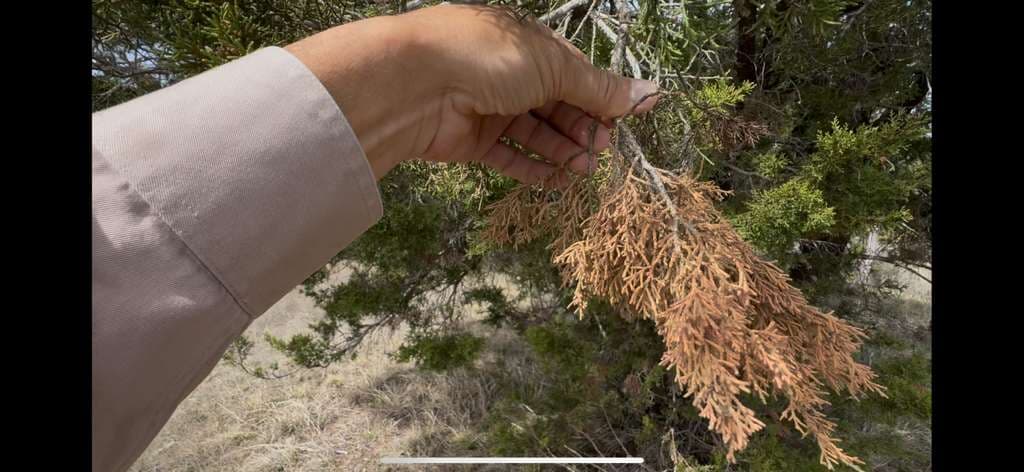
Red Mountain Cedar (Juniperus pinchotii) is a native conifer species common throughout Parker County and much of North Texas. While drought tolerant and well adapted to limestone soils, this species is highly susceptible to root stress and secondary pathogens when exposed to prolonged oversaturation.
In Weatherford, Texas, extended rainfall patterns from 2024 through early 2025 have created ideal conditions for decline in stressed junipers, including Red Mountain Cedar.
Initial Diagnosis – Foliar Necrosis and Canopy Thinning
The primary visual symptom observed was widespread foliar necrosis. Needles exhibited browning from the interior canopy outward, accompanied by thinning and loss of density.
Close inspection revealed two primary stress agents:
1. Spider mite infestation
2. Diplodia fungal activity
Both are common opportunistic problems in junipers when environmental stress weakens plant defenses.
Spider Mites on Juniperus pinchotii
Spider mites (Tetranychidae family) are not insects but arachnids that feed by piercing needle tissue and extracting cellular contents.
H3: Why Spider Mites Thrive on Stressed Cedars
When Red Mountain Cedar is physiologically stressed, carbohydrate reserves decline. The tree’s ability to produce defensive compounds (such as terpenes and phenolics) weakens.
Mite feeding results in:
- Chlorotic stippling
- Needle desiccation
- Reduced photosynthetic efficiency
- Progressive canopy thinning
Severe infestations can accelerate decline rapidly in already stressed trees.
Diplodia Tip Blight (Diplodia spp.)
Diplodia fungi infect weakened conifer tissue, particularly when high humidity and prolonged moisture are present.
Infection Mechanism
Diplodia spores colonize:
- Stressed needle tissue
- Young shoots
- Wounded areas
Symptoms include:
- Browning of tips
- Black pycnidia (fruiting bodies)
- Progressive dieback
Diplodia is typically secondary — meaning it attacks trees already compromised by environmental stress.
Environmental Causation – Oversaturation & Root Hypoxia
The most critical contributing factor in this case is prolonged soil oversaturation from 2024 through 2025 rainfall patterns.
Unlike broadleaf hardwoods such as oaks, junipers are conifers with different vascular anatomy.
Red Mountain Cedar contains:
- Tracheids (long narrow conductive cells)
- No true vessel elements
Why Tracheids Matter
Tracheids conduct water more slowly and are more sensitive to oxygen deprivation. When water pools at the root flare:
- Soil pore space fills with water
- Oxygen diffusion is reduced
- Root respiration declines
- Hypoxia develops
- Fine feeder roots die
Root systems require oxygen for aerobic respiration. When saturated soils persist, tracheid-based conduction becomes impaired, leading to systemic stress.
Junipers are adapted to well-drained soils. Chronic pooling at the root flare is extremely problematic for this species.
Root Flare Saturation & Structural Implications
Pooling water around the root crown creates:
- Fungal favorability
- Increased Diplodia activity
- Reduced structural anchorage
- Nutrient uptake imbalance
Over time, root decline leads to canopy decline.
The tree cannot process high volumes of water because its tracheid-based vascular system is not adapted for prolonged saturated soil conditions.
Integrated Management Strategy
Treatment must address both pests and root environment.
1. Drainage Correction
- Improve surface drainage
- Eliminate pooling at root flare
- Remove compacted soil
- Avoid excessive irrigation
2. Spider Mite Mitigation
- Implement IPM strategy
- Monitor mite pressure
- Use appropriate miticides if thresholds exceeded
3. Diplodia Management
- Remove infected tips
- Improve airflow
- Apply fungicide where indicated
- Reduce stress triggers
4. Soil Oxygenation
- Incorporate organic matter
- Improve soil porosity
- Reduce compaction
The root environment must be corrected first. Foliar treatments alone will not resolve systemic decline.
Prognosis in Weatherford, Texas
Red Mountain Cedar is drought tolerant but poorly adapted to chronic saturation.
If oversaturation continues and root hypoxia persists:
- Spider mite pressure increases
- Diplodia spreads
- Canopy dieback accelerates
- Structural stability weakens
Early intervention focused on soil management provides the best chance for recovery.
Key Takeaway
In Weatherford, Texas, the combination of:
- Prolonged oversaturation
- Root hypoxia
- Spider mite feeding
- Diplodia fungal colonization
creates a cascade of decline in Juniperus pinchotii.
Correcting soil drainage and reducing environmental stress is more important than simply spraying foliage.
Tree health begins at the root system.
For general tree-care best practices, homeowners can also reference guidance from the Texas A&M Forest Service, https://tfsweb.tamu.edu/trees/, a trusted authority on Texas tree health.
Schedule a professional inspection. Early detection and scientific intervention are the difference between preservation and loss. If you’d like to speak to an arborist, please call us at 817-880-6130 or visit https://www.arboristusa.com/