 4.9 (349 Reviews)
Root Rot, Entomosporium Leaf Spot, and Environmental Stress
Red tip photinia (Photinia × fraseri) is widely planted in North Texas for screening and ornamental color, but it can decline quickly when root-zone conditions stay wet and foliage remains frequently splashed. In Weatherford, Texas, the combination of saturated soils, damaged root flare tissue, and repeated moisture on the canopy creates ideal conditions for a disease complex that often includes root rot below ground and Entomosporium leaf spot above ground. Texas A&M AgriLife identifies Entomosporium leaf spot as a major disease of photinia and notes that spores are spread by splashing water and wind, especially during cool, wet periods.
In this case, the decline pattern is not being driven by foliage disease alone. The larger problem begins at the root flare and lower stem, where excessive moisture, poor oxygen exchange, and root injury have weakened the shrub’s physiology. Once the root system is compromised, the canopy becomes far more susceptible to red spot disease, premature defoliation, dieback, and long-term decline. TCIA guidance consistently emphasize that canopy symptoms often reflect root-zone problems first, especially where compaction and saturation are present.
Primary Diagnosis – Entomosporium Leaf Spot on Red Tip Photinia
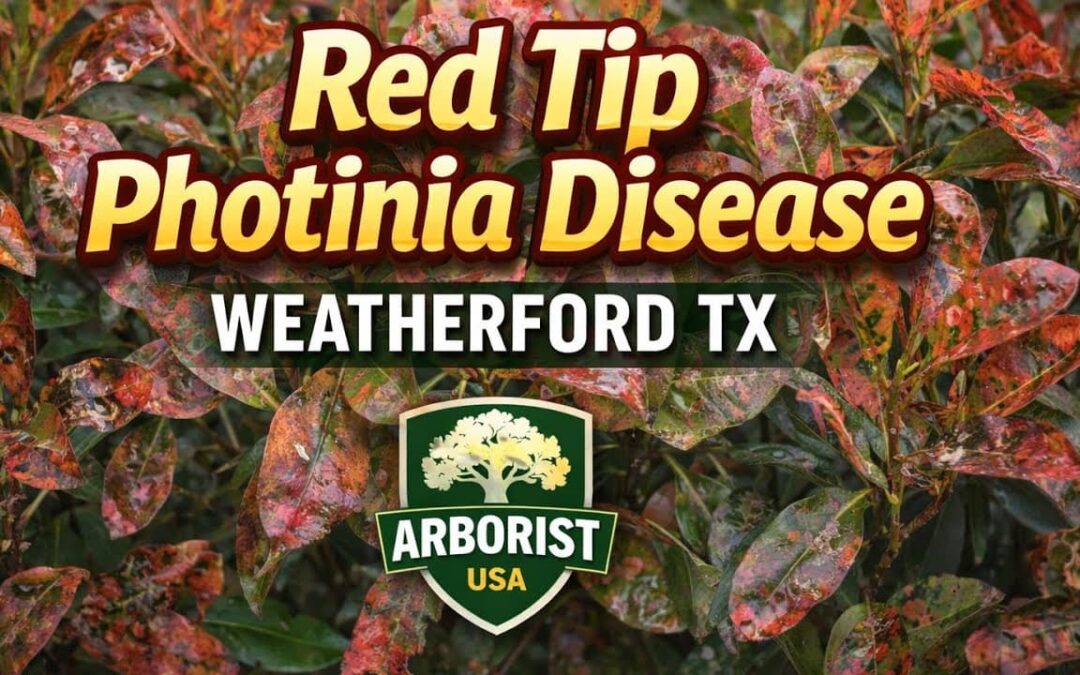
The red spotting and necrotic lesions on the foliage are consistent with Entomosporium leaf spot, a fungal disease commonly associated with red tip photinia. Texas A&M’s plant disease resources describe these lesions as expanding brown to gray leaf spots, often with darker margins, that can lead to severe premature leaf drop when infection pressure is high. On susceptible photinias, heavy infection can dramatically reduce the screening value of the plant, slow growth, and increase sensitivity to environmental stress.
Why the Disease Spreads So Fast
Texas A&M notes that diseased leaves, infected young shoots, and fallen foliage all serve as reservoirs for the fungus. Spores are released from late winter through much of the growing season, and they are spread primarily by splashing water and wind. That is why this disease often intensifies after repeated rainfall, overhead irrigation, or any condition that keeps foliage wet for extended periods. In a wet cycle, every water droplet can become a transport mechanism moving spores from infected tissue to healthy new growth.
That matters in Weatherford because repeated saturation from mother nature has likely extended the infection window. New, tender foliage is especially vulnerable, and once lesions build across the canopy, the shrub loses leaf area, photosynthetic capacity, and carbohydrate production. Texas A&M specifically notes that severe infection can cause premature defoliation, and that repeated wetness is a major driver of disease development.
Secondary Diagnosis – Root Rot and Root Flare Stress
The foliage disease is only half the story. Damage at the root flare and dieback in portions of the stems strongly suggest root-zone dysfunction and root rot pressure. Even when the exact organism is not lab-confirmed on site, the pattern of saturated soil, declining lower stem tissue, and chronic weakness points toward a water-mold or root-rot type condition that is being favored by excess moisture and poor aeration.
Why Root Rot Sets the Stage for Canopy Disease
When root systems remain in saturated soil, oxygen availability falls sharply. TCIA explains that compacted soils collapse pore space and reduce oxygen in the root zone, making it difficult for roots to respire. Standing water and prolonged saturation can suffocate roots, reduce water uptake regulation, and predispose woody plants to root pathogens and insect attack. Once roots are stressed, the canopy becomes thinner, less vigorous, and more vulnerable to opportunistic diseases.
This is the cascade: root rot and root stress weaken the plant first; then the foliage disease becomes more aggressive because the shrub no longer has the vigor needed to defend itself or replace damaged leaves. What looks like a “leaf problem” is often rooted in oxygen deprivation below ground. That is why fungicides on the canopy alone often fail to produce lasting results if the environment around the root flare is not corrected first. This conclusion aligns with TCIA-style diagnostic thinking, where the causal chain must be addressed rather than just the visible symptom.
Environmental Causation – Oversaturation, Compaction, and Splash Dispersal
The dominant environmental driver here is oversaturation. In prolonged wet periods, soils remain waterlogged, especially in compacted landscape beds where drainage is poor. When oxygen is displaced by water, roots cannot perform normal respiration. Fine roots begin to fail, the root flare stays chronically wet, and the lower stem tissues become far more vulnerable to breakdown.
Why Water at the Root Flare Is So Destructive
The root flare is the transition zone where trunk tissue becomes root tissue. It is not designed to stay buried or stay wet. When compact soil or excess mulch traps moisture against this zone, the plant loses proper drying cycles. TCIA articles on abiotic tree disorders and pneumatic soil excavation both note that compacted or buried flare areas are strongly associated with decline, poor gas exchange, thinning canopies, and dieback. The same root-zone principles apply to woody shrubs like photinia.
Above ground, water splash is also a major contributor. Texas A&M specifically states that Entomosporium spores are spread by splashing water and that reducing leaf wetness is one of the most important management steps. Drip irrigation, reduced splash, and improved drying are all part of proper protocol. If the canopy stays wet and the bed stays saturated, both the root problem and the foliage disease keep reinforcing each other.
Why Fungicides Help but Often Do Not “Fix” the Problem
This is one of the most important points for homeowners to understand. Fungicides do not always solve chronic photinia decline because they do not change the environment. Texas A&M explains that fungicides can be used effectively to protect new foliage when conditions are favorable for Entomosporium development, but cultural corrections are also essential: sanitation, airflow, reduced wetness, and careful irrigation. Fungicides are not always needed during hot, dry periods, which further shows that environment is the main driver.
In practical terms, fungicides can suppress the spread to new tissue, but infected leaves may still wither, spot, and drop. That is why contaminated foliage often needs to be removed from the shrub and from the ground beneath it. Texas A&M recommends removing fallen diseased leaves and reducing wet foliage periods to cut inoculum levels and slow new infection cycles.
Corrective Treatment Plan for Weatherford Red Tip Photinias
The treatment sequence should prioritize the environment first, then support the plant biologically, then use chemistry as a suppression tool.
Step 1 – Correct the Root Flare Environment
Compacted soil around the root flare should be removed to promote oxygen exchange and allow the root crown to dry properly between rain events. The goal is to expose the flare, stop chronic waterlogging, and restore air movement into the upper root zone. This follows the broader TCIA principle that root flare inspection and remediation are essential whenever woody plants show unexplained dieback or canopy thinning.
Step 2 – Improve Drainage and Reduce Splash
Water must not remain trapped at the base of the shrub. Drainage pathways should be established so excess rainfall can move away from the flare zone. Overhead irrigation should be minimized or eliminated where possible, and irrigation should be timed to avoid prolonged leaf wetness. Texas A&M explicitly recommends watering only when necessary and favoring drip or surface watering so foliage stays dry.
Step 3 – Suppress Root Rot Pressure
A product such as Subdue Maxx may be warranted if a water-mold type root issue is suspected. That type of treatment is not a substitute for drainage correction; it is a support measure meant to reduce pathogen pressure while the environment is being corrected. When the site stays wet, even strong products tend to provide only temporary relief.
Step 4 – Protect New Canopy Tissue
The canopy should be sprayed with an appropriate antifungal to help reduce spread into new growth. Texas A&M identifies preventive fungicide use during cool, wet conditions as one of the accepted management tools for Entomosporium. The purpose is to protect new tissue while sanitation and drainage are addressed.
Step 5 – Remove Necrotic Foliage Promptly
Brown, tan, and heavily spotted leaves should be pruned and cleaned out as they decline. Diseased leaves on the plant and on the ground beneath the plant act as inoculum sources. Texas A&M specifically recommends removing fallen infected leaves, especially before spring flush, to reduce the amount of spore-producing material in the landscape.
Step 6 – Promote New Growth and Root Recovery
A low-nitrogen root stimulator such as a 2-2-3 product can help support new feeder-root development and moderate canopy recovery without forcing excessive succulent growth. Carbohydrate supplementation and dried molasses-type biological feeding can support microbial activity in the rhizosphere, helping nutrient cycling and soil structure over time. Seaweed carbon can further improve nutrient bioavailability and stress tolerance. While these tools are supportive rather than curative, they are valuable when used alongside environmental correction.
The Importance of Annual Arborist Evaluations
Conifers and broadleaf evergreens often decline slowly, then suddenly look bad all at once. Annual inspections by an Arborist matter because the earliest stages of trouble are often environmental, not dramatic. A trained arborist evaluates root flare exposure, soil compaction, drainage, canopy pattern, pest pressure, and disease spread together—not as isolated symptoms.
In a case like this, yearly evaluations can help determine whether the shrub is stabilizing, whether the root zone is improving, and whether treatments should continue or be adjusted.
Final Takeaway for Weatherford, Texas
Red tip photinia decline in Weatherford is often not caused by just one thing. In this case, root rot and chronic root-zone stress are weakening the shrub first, and Entomosporium leaf spot is taking advantage of that stress. Repeated rainfall, saturated soil, compacted root-flare conditions, and splash dispersal are driving the disease cycle.
- The most important fix is environmental:
- improve drainage,
- restore oxygen to the root flare,
- reduce splash to the canopy,
- remove infected tissue,
- and support root recovery.
Fungicides can help suppress the problem, but they do not replace site correction. Healthy growth returns only when the root system can breathe.
For general tree-care best practices, homeowners can also reference guidance from the Texas A&M Forest Service, https://tfsweb.tamu.edu/trees/, a trusted authority on Texas tree health.
Schedule a professional inspection. Early detection and scientific intervention are the difference between preservation and loss. If you’d like to speak to an arborist, please call us at 817-880-6130 or visit https://www.arboristusa.com/