 4.9 (349 Reviews)
In Granbury, Texas, tree risk assessments are critical when structural defects and decay compromise the integrity of a tree—especially when high-value targets such as children’s play areas are within the impact zone.
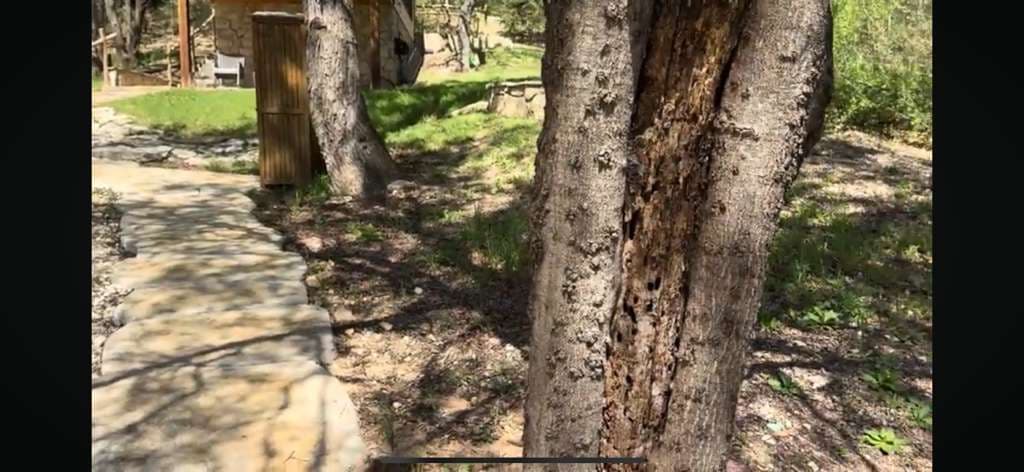
This assessment focuses on a mature Shumard red oak (Quercus shumardii) exhibiting severe basal wound damage, extensive internal decay, and a high-consequence failure scenario.
Observed Structural Defect and Site Conditions
During the on-site evaluation, a major longitudinal basal wound was identified on the south-facing side of the trunk, extending from the root flare upward to a codominant stem union.
The wound measures approximately 9 feet in length and approximately 9 inches in width, exposing internal wood tissue and indicating long-term structural compromise.
Additional contributing factors include:
• Tree positioned on a slope, creating a gravitational load bias toward the घायल side
• Decay column extending vertically through critical load-bearing wood
• Visible breakdown of structural integrity along the trunk axis
• Proximity to a children’s playground, increasing consequence rating
This combination creates a structurally compromised system under continuous mechanical stress.
Likelihood of Failure vs. Consequence of Failure
According to ISA Tree Risk Assessment Qualification (TRAQ) methodology and ANSI A300 Part 9 guidelines:
• Likelihood of Failure: Medium
• Likelihood of Impact: High
• Consequence of Failure: Severe
The target zone includes an active children’s play area, where failure could result in:
• Severe bodily injury
• Fatality
• Property damage
While the probability of failure is classified as “medium,” the severity of consequence elevates the overall risk rating to an unacceptable level.
As outlined by the International Society of Arboriculture (ISA), risk is a function of both likelihood and consequence—not likelihood alone.
The Science of Structural Failure: CODIT Breakdown
Trees defend against injury and decay through a biological process known as Compartmentalization of Decay in Trees (CODIT), first described by Dr. Alex Shigo.
This system consists of four “walls”:
• Wall 1: Limits vertical spread of decay
• Wall 2: Limits inward spread toward the pith
• Wall 3: Limits lateral spread around the trunk
• Wall 4: The barrier zone, new tissue formed after injury
In this Shumard red oak, the following conditions were observed:
• Walls 1–3 have failed, allowing decay organisms to spread longitudinally and radially through the structural wood
• Wall 4 is actively forming, but is insufficient to contain the rate and extent of decay
• Internal wood fibers (cellulose and lignin structure) are degraded, reducing load-bearing capacity
According to ISA and Texas A&M AgriLife Extension, once structural wood degradation exceeds the tree’s ability to compartmentalize, failure potential increases significantly—especially under environmental loads such as wind or gravitational stress.
Structural Mechanics and Gravity Load on a Slope
The tree’s position on a slope introduces an additional biomechanical concern.
The center of gravity is shifted toward the wounded and decayed side of the tree, increasing tensile stress on already compromised wood fibers.
This creates:
• Uneven load distribution
• Increased bending moment at the base
• Higher probability of shear failure at the decay column
ANSI A300 standards emphasize that structural defects combined with site conditions must be evaluated together—not in isolation.
In this case, slope + decay + target = compounded risk.
Why Removal Is the Recommended Course of Action
Based on ISA, TCIA, and ANSI A300 risk assessment protocols, this tree meets the criteria for removal due to:
• Advanced structural decay with failed CODIT walls
• Significant loss of load-bearing wood
• High-value target within the impact zone
• Environmental factors increasing mechanical stress
• Inability to mitigate risk through pruning or treatment
There is no viable corrective pruning or plant health care treatment that can restore structural integrity once decay has progressed to this level.
The risk cannot be reduced to an acceptable level without removal.
Risk Management and Property Protection
Tree risk management is not just about the tree—it is about protecting:
• Human life
• Property
• Liability exposure
According to the Tree Care Industry Association (TCIA), proactive removal of high-risk trees is a critical component of responsible property management.
Delaying action in situations like this increases the probability of catastrophic failure.
Professional Recommendation
It is the professional recommendation to remove this Shumard red oak in its entirety to eliminate the risk of structural failure and prevent potential injury or loss of life.
All work should be performed in accordance with ANSI A300 standards and industry best practices to ensure safe and controlled removal.
Call to Action
If you have a tree on your property showing signs of decay, structural damage, or leaning toward a target, do not wait until failure occurs.
For general tree-care best practices, homeowners can also reference guidance from the Texas A&M Forest Service, https://tfsweb.tamu.edu/trees/, a trusted authority on Texas tree health.
Arborist USA specializes in advanced tree risk assessment, plant health care, and hazard mitigation throughout Granbury, Texas and surrounding areas.
Schedule a professional inspection. Early detection and scientific intervention are the difference between preservation and loss. If you’d like to speak to an arborist, please call us at 817-880-6130 or visit https://www.arboristusa.com/