 4.9 (349 Reviews)
Professional Tree Risk Assessment Using ISA & ANSI A300 Standards
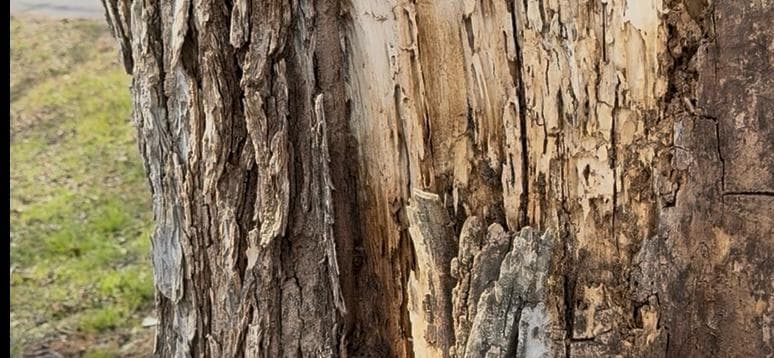
Tree Risk Assessment Joshua, TX: A professional tree risk assessment was performed on a large American elm located in Joshua, Texas. This assessment follows the ISA Tree Risk Assessment (TRAQ) principles and ANSI A300 standards, which evaluate tree health and structural stability based on biological, mechanical, decay progression, and target exposure factors. Tree risk assessments are not opinions or visual guesses. They are structured evaluations used by certified arborists, municipalities, and insurance professionals to determine whether a tree presents a low, medium, or high risk of failure. In this case, the tree was classified as HIGH RISK, indicating that the likelihood of failure, the likelihood of impact, and the consequences of failure are all elevated.
Key Structural Defects Identified in the American Elm
Advanced Basal Rot at the Trunk Flare
The most critical defect identified is advanced basal rot located at the trunk flare and extending upward into the primary load-bearing zone of the tree. The base of a tree is responsible for transferring the full weight of the crown into the root system. When decay compromises this area, structural stability is significantly reduced. Basal decay is one of the most dangerous forms of tree failure because it often leads to sudden, catastrophic collapse without warning.
CODIT Failure and Accelerating Internal Decay
Trees rely on a biological defense system called CODIT (Compartmentalization of Decay in Trees) to isolate wounds and decay. In this American elm, CODIT Walls 1 through 3 have failed, meaning decay is spreading vertically, radially, and laterally within the trunk. Wall 4, which represents new barrier tissue, is forming too slowly to stop the progression of decay. The result is a tree where decay is advancing faster than the tree can defend itself, making recovery impossible.
Flatheaded Wood-Borer Damage
Extensive flatheaded wood-borer galleries were observed within the trunk. These insects target stressed and decaying trees and further reduce the amount of sound structural wood available to support the tree. Borer activity combined with fungal decay significantly accelerates structural failure.
Structural Load Failure and Codominant Stem Risk
Two Massive Codominant Stems with Compromised Union
The tree has two large codominant stems, together carrying an estimated load exceeding 35,000 pounds. The decay zone extends directly into the junction where these stems meet, which is one of the most critical stress points in the tree. When decay intersects a high-load junction, the likelihood of sudden failure increases dramatically. This type of defect cannot be corrected with pruning or cabling because there is insufficient sound wood remaining.
Large Dead Scaffold Limbs in the Crown
Multiple dead scaffold limbs were identified throughout the canopy, several exceeding 8 inches in diameter. These limbs represent independent failure points and can fall without warning, even if the trunk remains standing.
Target Assessment and Public Safety Risk
This tree is located adjacent to a busy street in Joshua, TX, with frequent pedestrian and vehicle traffic. Nearby structures are also within the failure zone.
Under ISA Tree Risk Assessment standards:
Likelihood of failure: High
Likelihood of impact: High
Consequences of failure: Severe
This combination results in an overall HIGH RISK rating.
Why Pruning or Cabling Is Not a Safe Option
Structural pruning, cabling, and bracing rely on having adequate sound wood to redistribute load forces. In this case, advanced basal decay, failed CODIT response, and borer damage have eliminated the structural integrity required for those mitigation techniques. Attempting to retain this tree would create a false sense of safety while leaving people and property at
risk.
Professional Recommendation – Immediate Removal
Based on observed conditions at the time of inspection, this American elm poses an imminent failure risk. Failure could occur at any time, especially during wind, rain, or soil saturation events. Removal is the only responsible and defensible option to eliminate risk and protect the homeowner, pedestrians, and surrounding community.
Tree Risk Assessments in Joshua, TX
Tree risk assessments are a proactive way to identify hazards before emergencies happen. Not all dangerous trees look dead from the outside. Internal decay and structural defects often go unnoticed until failure occurs. If you are concerned about a tree on your property in Joshua or surrounding North Texas areas, a professional assessment can help you make
informed, science-based decisions. For general tree-care best practices, homeowners can also reference guidance from the Texas A&M Forest Service, https://tfsweb.tamu.edu/trees/, a trusted authority on Texas tree health.
If you’re looking for professional, dependable tree care, Arborist USA is here to help. Our certified arborists provide expert evaluations and guidance tailored to Joshua’s growing conditions. ISA Certified Arborists are trained in tree biology, risk assessment, and diagnosis, following standards established by the International Society of Arboriculture (ISA).
Tree Risk Assessment Explained: Why This American Elm Is a High-Risk Failure (ANSI A300 & ISA)
Call 817-880-6130
Visit ArboristUSA.com