 4.9 (349 Reviews)
Why Proper Tree Planting Matters in Granbury, TX
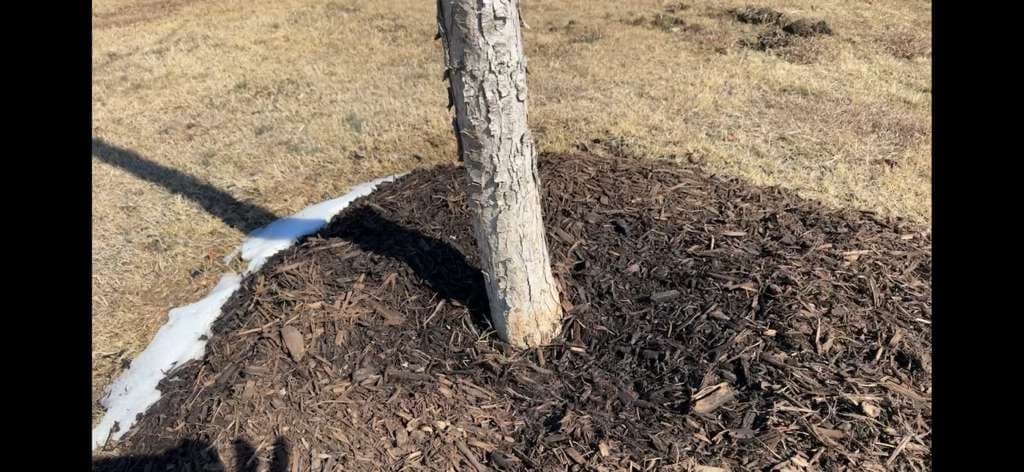
Inspecting newly planted trees: common mistakes homeowners make in Granbury, Texas. In Granbury, Texas, newly planted trees often struggle not because of disease or pests, but because of improper planting and post-planting practices. One of the most common and damaging mistakes homeowners make is incorrect mulch placement and root flare burial.
According to ISA and TCIA standards, tree establishment success is largely determined during the first few years after planting. Errors made early can lead to long-term stress, poor structural development, and premature decline.
The Most Common Mistake: Root Flare Burial
What Is the Root Flare?
The root flare, also called the root collar, is the transition zone where the trunk widens and structural roots begin. This area is biologically designed to be:
• Exposed to air
• Well oxygenated
• Free from constant moisture and soil contact
When planted correctly, the root flare should be clearly visible at the soil surface.
Root Collar Burial and the “Telephone Pole Effect”
In newly planted trees across Granbury and North Texas, it is common to see the trunk disappear straight into the ground without any visible flare. This condition is known as root collar burial.
In the field, arborists often refer to this as the telephone pole effect, where the tree looks like a post driven into the soil rather than a naturally flared trunk.
This condition is frequently caused by excessive mulch accumulation, also known as a mulch volcano.
Why Excessive Mulch Is a Problem (The Science)
Oxygen Deprivation and Hypoxic Soil Conditions
Tree roots require oxygen for respiration. When mulch is piled against the trunk, it:
• Reduces gas exchange
• Traps moisture against bark tissue
• Creates hypoxic (low-oxygen) soil conditions
This environment stresses the tree and interferes with normal root function.
Increased Risk of Decay and Girdling Roots
Root collar burial increases the likelihood of:
• Collar rot and bark decay
• Development of adventitious or girdling roots
• Poor buttress root formation
Over time, these conditions can compromise structural stability and increase failure risk as the tree matures.
Newly Planted Trees Are Especially Vulnerable
Newly planted trees have limited root systems and are still adjusting to site conditions. In Granbury’s clay and compacted soils, oxygen availability is already reduced, making proper planting depth and mulch management even more critical.
Correcting root flare exposure early greatly improves:
• Root respiration
• Establishment speed
• Long-term health and stability
Proper Mulching According to ISA and TCIA Standards
How to Mulch Correctly
ISA and TCIA best practices recommend:
• Mulch depth of 2–3 inches maximum
• Mulch kept 6–8 inches away from the trunk
• Mulch shaped like a flat donut, not a cone
The entire root flare should remain fully exposed.
Proper Watering for Newly Planted Trees in Granbury
Deep, Slow Watering Is Key
For newly planted trees of this size, proper watering is just as important as correct mulch placement.
General guideline:
• 75–100 gallons per watering
• Apply water slowly, allowing it to soak deeply
• Water deeply but infrequently, adjusting for rainfall and soil drainage
Frequent shallow watering encourages surface roots and reduces drought resilience.
Signs Homeowners Should Watch For
Improper planting and mulch practices may not cause immediate decline. Watch for:
• Poor growth or delayed establishment
• Thinning canopy
• Early leaf drop
• Stress symptoms during summer heat
Early correction is far easier and less costly than addressing long-term damage.
For general tree-care best practices, homeowners can also reference guidance from the Texas A&M Forest Service, https://tfsweb.tamu.edu/trees/, a trusted authority on Texas tree health.
Professional Tree Inspections in Granbury, Texas
Inspecting newly planted trees early helps prevent years of hidden stress. A professional evaluation by Arborist USA can determine whether a tree was planted correctly and whether cultural corrections are needed to ensure long-term success.
If you have newly planted trees in Granbury, Texas, Arborist USA provides evaluations grounded in ISA standards, ANSI A300 practices, and TCIA guidance, focusing on prevention, education, and long-term tree health.
If you’d like to speak to an arborist, please call us at 817-880-6130 or visit https://www.arboristusa.com/