 4.9 (349 Reviews)

By Henry G. Friar | ISA Certified Arborist® TX-270627A | TDA License No. 1008483 | TCIA Member #268065 | Arborist USA
Italian Cypress trees can create a spectacular architectural landscape, but keeping them healthy in Fort Worth, Texas, requires careful management of drainage, fungal diseases, spider mites, soil conditions, and seasonal environmental stress. At Arborist USA, we have been caring for an exceptional group of mature Italian Cypress trees estimated to be approximately 50 years old, measuring an estimated 75–100 feet tall with canopy spreads of approximately 11 feet. Despite past problems involving Diplodia, Seiridium canker, and spider mites, our ongoing Plant Healthcare program has helped maintain their health and appearance.
One of the Most Impressive Italian Cypress Landscapes I’ve Seen in Fort Worth
Hello Community, my name is Henry G. Friar, ISA Certified Arborist with Arborist USA, here in Fort Worth, Texas.
Today, we’re visiting a property with some of the largest and most mature Italian Cypress trees I’ve personally encountered in the Fort Worth area.
These remarkable trees are estimated to be approximately 50 years old, standing between 75 and 100 feet tall, with a canopy spread of approximately 11 feet.
Italian Cypress (Cupressus sempervirens) is known for its narrow, upright growth habit and distinctive architectural appearance.
However, maintaining these trees in North Texas is not easy.
Over the years, these particular trees have experienced fungal disease pressure, including suspected or previously identified Diplodia and Seiridium canker, along with spider mite infestations.
Fortunately, through ongoing maintenance, disease management, insect monitoring, and attention to soil conditions, we have been able to help preserve their health.
These trees are a good example of why mature landscape specimens require a long-term Plant Healthcare strategy rather than occasional treatments after problems become severe.
Why Italian Cypress Trees Struggle in North Texas
Italian Cypress originated in the Mediterranean region, where summers are typically hot and dry and winters are relatively mild.
Their natural adaptation to well-drained growing environments creates challenges in North Texas landscapes.
Here in Fort Worth, our weather conditions can fluctuate dramatically.
We may experience extended periods of drought followed by intense spring thunderstorms, prolonged rainfall, saturated soils, and rapid temperature changes.
Although Italian Cypress can tolerate some cold weather and drought once established, they are particularly vulnerable when environmental stress combines with poor drainage or disease pressure.
The Problem With Excessive Soil Moisture
One of the most important factors affecting Italian Cypress health is the amount of oxygen available within the root zone.
Roots require oxygen for cellular respiration.
When soil becomes saturated, water fills the pore spaces that normally contain air.
This reduces oxygen availability and can create root-zone hypoxia.
As oxygen becomes limited, roots struggle to maintain normal metabolic activity, absorb nutrients, and transport water into the canopy.
Over time, prolonged saturation may contribute to root mortality, reduced vigor, and increased susceptibility to certain root pathogens.
Italian Cypress trees generally perform best in well-drained soils and should not be subjected to prolonged waterlogging.
Why Spring Rainfall Can Become a Problem
During wet spring seasons in North Texas, heavy rainfall can exceed the infiltration and drainage capacity of compacted or clay-rich soils.
When water remains in the root zone for extended periods, the trees may experience physiological stress even though the soil contains abundant moisture.
This is why I place so much emphasis on proper drainage.
Where site conditions justify it, a properly engineered drainage system may be necessary to move excess water away from the root zone.
However, drainage systems should be designed around actual soil conditions, water movement, and the surrounding landscape.
Installing drainage excavation directly through major structural roots can create additional problems.
The goal is to improve water movement without damaging the roots that support the trees.
Seiridium Canker — A Serious Fungal Disease of Italian Cypress
One of the most concerning diseases affecting Italian Cypress is Seiridium canker.
This disease is associated with fungal pathogens in the genus Seiridium.
How Seiridium Canker Damages Cypress Trees
Seiridium canker affects woody tissues, including branches and stems.
The pathogen can enter through wounds or susceptible tissues and cause localized areas of tissue death.
These infected areas are called cankers.
As a canker expands, it can damage the cambium and disrupt the movement of water and nutrients through affected tissues.
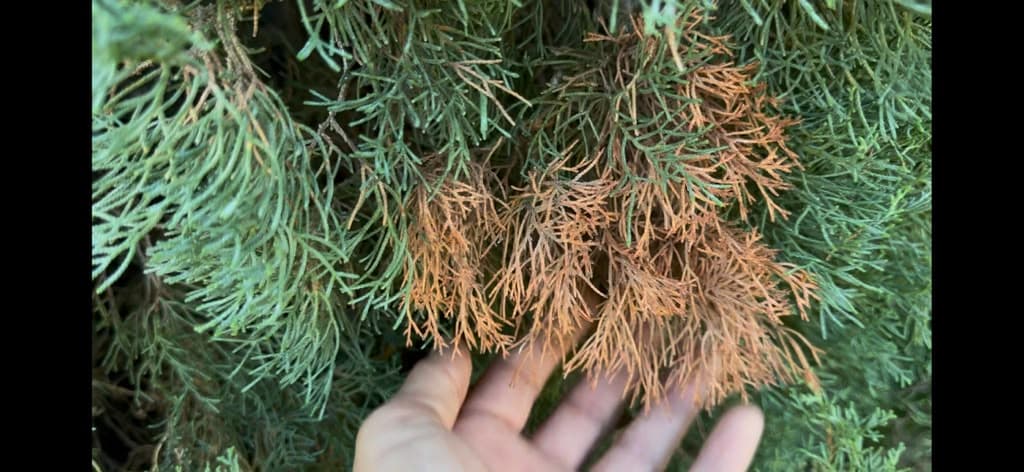
When a canker girdles a branch, foliage beyond the infected area may turn yellow, reddish-brown, or completely brown.
Common symptoms include:
- Individual branches turning brown.
- Localized areas of dead bark.
- Resin bleeding from infected tissues.
- Progressive branch dieback.
- Scattered dead foliage throughout the canopy.
Severe infections can reduce canopy density and compromise the appearance and health of the tree.
Why Environmental Stress Matters
Environmental stress can increase the severity of canker problems.
Drought, root dysfunction, physical injuries, and other unfavorable growing conditions can reduce the tree’s ability to compartmentalize infected tissues.
Although saturated soil does not directly cause Seiridium canker, poor drainage may contribute to the physiological stress that makes disease management more difficult.
Our Management Approach
At Arborist USA, our management strategy emphasizes sanitation, environmental correction, and regular monitoring.
When appropriate, we remove dead and infected branches using proper pruning techniques.
Pruning equipment should be cleaned and disinfected as appropriate to reduce the risk of transferring pathogens between susceptible plants.
We also work to correct irrigation and drainage problems that contribute to unnecessary stress.
It is important to understand that fungicides are not a reliable cure for established Seiridium cankers.
Removing affected tissues when feasible and improving growing conditions are central parts of management.
Diplodia Tip Blight — Another Potential Cause of Cypress Dieback
Another disease concern on these mature Italian Cypress trees has been Diplodia-associated tip and branch dieback.
Fungi within the Diplodia group can be associated with shoot and branch diseases on various conifers.
However, several different fungal pathogens can produce similar symptoms on Italian Cypress.
For that reason, laboratory identification is important when the precise pathogen is uncertain.
How Tip Blight Affects Cypress Growth
When susceptible shoots become infected, the developing foliage may discolor, stop growing, and eventually die.
Depending on the pathogen and severity, symptoms may include:
- Browning of branch tips.
- Progressive twig dieback.
- Reduced canopy density.
- Dead shoots scattered throughout the tree.
These symptoms can resemble drought injury, Seiridium canker, spider mite damage, or root-related stress.
This is why a visual symptom alone should not be considered definitive proof of Diplodia infection.
Treatment and Prevention
Our approach focuses on confirming the cause of dieback, correcting environmental stress, removing dead tissues where appropriate, and monitoring disease progression.
Fungicides may be considered for specific confirmed diseases when an effective product is registered and labeled for the intended use.
However, chemical treatments cannot restore tissues that have already died.
The objective is to protect healthy growth and reduce conditions that contribute to continued decline.
Spider Mites — Small Pests That Can Cause Major Problems
Spider mites are another concern for Italian Cypress trees in North Texas.
These tiny arachnids feed on plant cells and can cause foliage discoloration, bronzing, and premature needle or scale-like foliage loss.
How Spider Mites Damage Italian Cypress
Spider mites use specialized mouthparts to puncture plant cells and remove their contents.
As feeding increases, damaged foliage may develop a dull, yellowish, bronze, or brown appearance.
Severe infestations can reduce photosynthetic activity and contribute to canopy thinning.
Some mite species become especially problematic during hot, dry weather, while others are more active during cooler periods.
Therefore, identifying the mite species and monitoring population levels is essential.
Integrated Pest Management
At Arborist USA, our Integrated Pest Management program includes monitoring active mite populations, evaluating environmental stress, and considering beneficial predatory mites.
When treatment is justified, we select products labeled for the pest and application site.
Not all insecticides control spider mites.
In fact, certain broad-spectrum insecticides may eliminate natural predators and contribute to secondary mite outbreaks.
The goal is to manage pest pressure without unnecessarily disrupting beneficial organisms.
Seasonal Removal of Dead and Necrotic Cypress Branches
One of the most important maintenance practices for these mature Italian Cypress trees is the regular removal of dead and necrotic tissues.
Necrotic tissue is plant tissue that has died because of disease, injury, or environmental stress.
Once foliage and branches are completely dead, they will not become green again.
Why Seasonal Pruning Matters
Removing dead branches can improve the appearance of the tree, reduce deadwood hazards, and make it easier to monitor developing symptoms.
For these mature Italian Cypress trees, I recommend seasonal evaluations to identify new areas of dieback and determine whether pruning is appropriate.
However, pruning must be performed carefully.
Italian Cypress generally does not regenerate reliably from old, bare wood.
Excessive pruning can permanently damage the tree’s narrow, natural form.
We follow appropriate ANSI A300 pruning principles, avoiding unnecessary removal of living foliage and preserving the tree’s natural architecture.
The goal is not to reshape these magnificent trees aggressively.
The goal is to preserve healthy foliage while removing dead material and monitoring disease progression.
Our Long-Term Italian Cypress Plant Healthcare Program
Maintaining mature Italian Cypress trees requires more than occasional spraying.
Our program focuses on the entire growing environment.
1. Soil Testing and Nutritional Management
We evaluate soil nutrient availability and pH before recommending fertilization.
A properly designed fertilization program may help support growth when nutrient deficiencies or other site conditions justify treatment.
However, excessive nitrogen can encourage undesirable growth and should not be applied automatically.
Fertilization is not a cure for fungal cankers or root decay.
2. Organic Matter and Compost
Organic matter plays an important role in soil structure, biological activity, and moisture regulation.
Where soil conditions warrant it, we may incorporate or topdress suitable finished compost.
For mineral soils, approximately 5% organic matter is sometimes used as a general soil-management reference, but it should not be treated as a universal target for every Italian Cypress landscape.
The appropriate amount depends on existing soil organic matter, drainage, texture, and laboratory findings.
Compost should not be piled against the trunk or used in a way that traps excess moisture around the root collar.
3. Proper Mulching
Organic mulch can help moderate soil temperatures, reduce evaporation, and protect the root zone.
We generally recommend maintaining an appropriate mulch layer while keeping the trunk and root flare exposed.
Excessive mulch accumulation against the trunk can retain moisture and create unfavorable conditions around the bark.
4. Pneumatic Soil Aeration
When soil compaction restricts root development and gas exchange, pneumatic soil aeration may be beneficial.
Using specialized equipment such as an AirSpade, we can loosen compacted soil and investigate root-zone conditions with less risk of cutting roots than conventional excavation.
The purpose is to improve soil porosity, oxygen movement, and root-growing conditions.
This work should be performed selectively to avoid damaging important structural roots.
5. Pest and Disease Monitoring
We monitor spider mite populations, inspect for cankers and new dieback, and evaluate overall canopy density.
When chemical treatment is justified, we select appropriately labeled products based on the diagnosed problem.
Preventive cultural practices remain an important part of reducing recurring stress.
6. Irrigation and Drainage Management
Italian Cypress requires a balance between available water and oxygen within the root zone.
During extended drought, supplemental irrigation may be necessary.
During prolonged rainfall, adequate drainage becomes especially important.
Irrigation should be adjusted according to actual soil moisture conditions rather than following the same schedule throughout the year.
Should Homeowners Plant Italian Cypress in Fort Worth, Texas?
This is where I want to share an important professional observation.
Although Italian Cypress can survive and grow in parts of North Texas, I generally do not recommend them as a low-maintenance landscape choice for Fort Worth homeowners.
These trees are adapted to a different climate and often require more attention than homeowners anticipate.
Our region experiences dramatic fluctuations in rainfall, temperature, and soil moisture.
We may experience extreme summer heat, extended drought, heavy spring rainfall, occasional severe freezes, and poorly drained soil conditions.
These stresses can create an unfavorable combination for Italian Cypress, particularly when fungal disease pressure is already present.
For homeowners considering new plantings, I encourage selecting species that are better suited to the site’s drainage, soil conditions, available space, and long-term maintenance expectations.
Italian Cypress is not universally unsuitable for North Texas, but successful establishment and long-term performance depend heavily on selecting an appropriate site.
Why Hiring an ISA Certified Arborist Matters
Italian Cypress can be challenging to maintain because multiple problems may produce similar symptoms.
Brown foliage might result from Seiridium canker, another fungal disease, spider mites, drought stress, saturated roots, or mechanical injury.
Applying the wrong treatment can waste money and delay correction of the actual problem.
An ISA Certified Arborist can evaluate the tree’s condition, identify likely causes of decline, and recommend appropriate management strategies.
At Arborist USA, we use science-based Plant Healthcare principles to guide our recommendations.
Our objective is to understand the relationship between the tree, the soil, the surrounding environment, and the biological organisms affecting its health.
We don’t simply treat symptoms. We investigate the underlying cause.
Final Thoughts — Preserving Mature Italian Cypress Trees in Fort Worth
These remarkable Italian Cypress trees represent decades of growth and an important investment in the landscape.
With estimated heights of 75–100 feet and approximately 50 years of history, they deserve a carefully managed preservation program.
Their continued health despite past disease and pest challenges demonstrates the value of consistent professional care.
Our ongoing strategy emphasizes proper drainage, seasonal removal of dead tissues, soil management, targeted nutritional support, pest monitoring, and disease management when necessary.
Although Italian Cypress can be a high-maintenance species in North Texas, mature trees in suitable locations may continue to thrive with appropriate care.
If your Italian Cypress trees are turning brown, developing fungal cankers, or experiencing spider mite damage, contact Arborist USA for a professional Plant Healthcare evaluation.
ARBORIST USA — WE SAVE SICK TREES!
Henry G. Friar
ISA Certified Arborist® TX-270627A
TDA License No. 1008483
TCIA Member #268065
Plant Healthcare Professional
Arborist USA
Office: 817-880-6130
Website: https://www.arboristusa.com/
For general tree-care best practices, homeowners can also reference guidance from the Texas A&M Forest Service, https://tfsweb.tamu.edu/trees/, a trusted authority on Texas tree health.
Schedule a professional inspection. Early detection and scientific intervention are the difference between preservation and loss. If you’d like to speak to an arborist, please call us at 817-880-6130 or visit https://www.arboristusa.com/
50-YEAR-OLD ITALIAN CYPRESS TREES — HOW DO WE KEEP THEM HEALTHY IN NORTH TEXAS? Hello Community, my name is Henry G. Friar, ISA Certified Arborist® TX-270627A, TDA License No. 1008483, TCIA Member #268065, with Arborist USA, here in Fort Worth, Texas. Today, we’re visiting a property with some of the largest and most mature Italian Cypress trees I’ve personally encountered in North Texas! These magnificent Italian Cypress (Cupressus sempervirens) are estimated to be approximately 50 years old, standing 75–100 feet tall, with canopy spreads of approximately 11 feet.