 4.9 (349 Reviews)

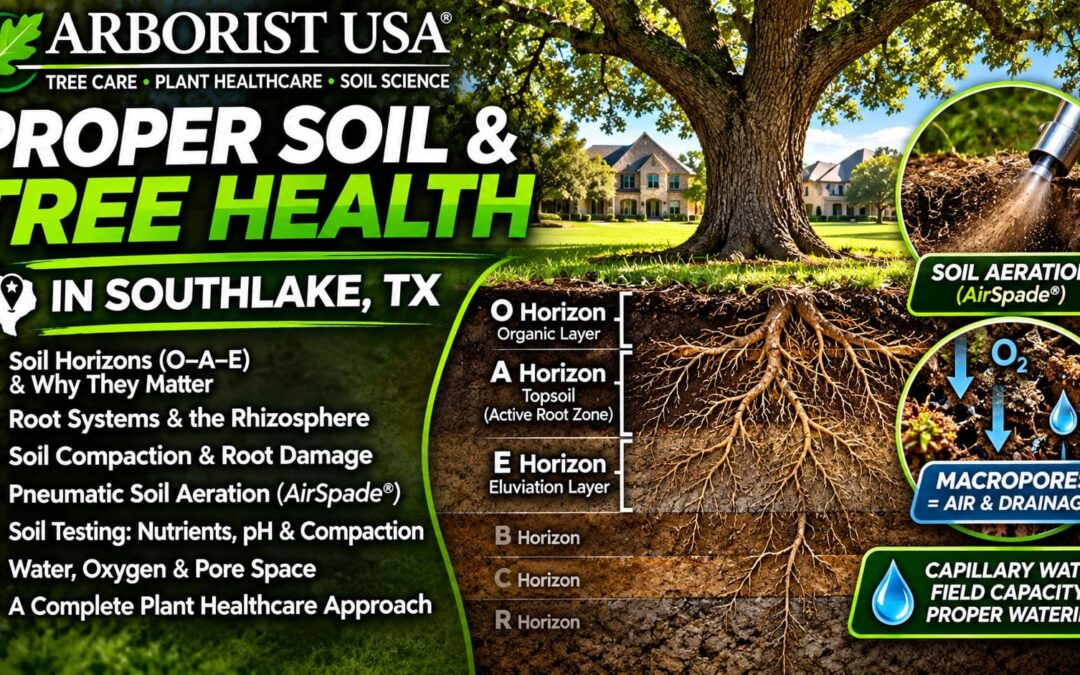
When I visit properties throughout Southlake, Texas, one of the first things I evaluate is not necessarily the tree canopy. It’s the soil beneath the tree.
Why?
Because some of the most serious problems affecting mature trees begin underground, long before homeowners notice yellowing foliage, thinning canopies, dead branches, or declining growth.
I regularly encounter beautiful landscapes where mature live oaks, red oaks, cedar elms, and other hardwoods are surrounded by manicured lawns, irrigation systems, sidewalks, driveways, and newly constructed homes.
Everything may look beautiful above ground.
But what is happening beneath the soil surface?
Have vehicles been parked over the root system? Has heavy construction equipment repeatedly traveled across the landscape? Has the soil become compacted? Are the absorbing roots receiving adequate oxygen? Is water infiltrating properly? Are essential nutrients actually available to the tree?
These questions are fundamental to professional Plant Healthcare.
Today, I want to explain the science of soil horizons, soil compaction, oxygen availability, soil-water relationships, and the importance of maintaining a biologically active root zone.
Most importantly, I want homeowners in Southlake and throughout North Texas to understand why protecting the soil is one of the most valuable things they can do for their trees.
⸻
1. Understanding Soil Horizons: The Foundation of Healthy Tree Growth
Soil is not simply dirt.
A developed soil profile contains layers called soil horizons. These layers differ in organic matter, mineral composition, biological activity, water movement, and other physical and chemical properties.
The major soil horizons are commonly identified as:
O – A – E – B – C – R
Not every landscape contains all six horizons. Construction, grading, erosion, and natural soil development can change or eliminate individual layers.
However, understanding these horizons helps explain where roots grow and why soil management is so important.
O Horizon — The Organic Layer
The O horizon consists primarily of organic materials at different stages of decomposition.
These materials may include fallen leaves, decomposing wood, and other plant residues.
This layer supports the cycling of organic carbon and nutrients.
As organic materials decompose, soil organisms help transform them into compounds that contribute to the surrounding soil.
The O horizon also helps protect the soil surface against excessive temperature fluctuations, erosion, and moisture loss.
In natural woodlands, this layer can be extremely important.
In maintained residential landscapes, however, the O horizon is frequently reduced or removed through repeated leaf collection, landscape cleanup, and soil disturbance.
Why does this matter?
Because removing organic materials also removes a natural source of carbon and nutrients that would otherwise return to the soil.
At Arborist USA, we frequently recommend maintaining an appropriate organic mulch layer and preserving healthy natural leaf litter where practical.
These practices help support long-term soil health.
A Horizon — The Topsoil and Biologically Active Root Zone
The A horizon is mineral topsoil containing varying amounts of organic matter.
For many landscape trees, this is one of the most important soil layers.
Why?
Because it commonly contains substantial populations of fine absorbing roots, microorganisms, and biologically active soil.
This is where important processes occur:
- Fine roots absorb water and dissolved mineral nutrients.
- Microorganisms participate in organic matter decomposition.
- Nutrients are released and transformed through biological and chemical processes.
- Soil aggregates and pore spaces help regulate water movement and oxygen availability.
- Roots interact with bacteria, fungi, and other organisms.
The A horizon is also highly vulnerable to compaction from vehicles, machinery, repeated traffic, and construction activities.
When this layer becomes compacted, the tree may experience reduced root growth, restricted oxygen exchange, and impaired water infiltration.
E Horizon — The Eluviation Layer
The E horizon is a mineral soil layer that has experienced eluviation.
Eluviation means the removal or downward movement of certain materials, including clay, iron, aluminum compounds, and organic substances, through water movement.
Because some of these materials have been removed, the E horizon may appear lighter in color.
The E horizon is not necessarily nutrient-rich. Its importance depends on its texture, structure, drainage characteristics, and position within the soil profile.
Roots may occupy this layer when moisture, oxygen, and physical conditions are favorable.
In some soils, the E horizon is absent.
The important principle is that the upper soil profile—including the O, A, and E horizons where present—must maintain healthy structure and appropriate water and oxygen conditions.
B Horizon — The Subsoil
The B horizon commonly accumulates materials transported from upper horizons, including clay and certain iron or aluminum compounds.
This accumulation process is called illuviation.
In many North Texas landscapes, clay-rich subsoil can influence water movement, root penetration, and drainage.
Dense subsoil layers may slow downward water movement, especially when they have low hydraulic conductivity.
However, roots can grow into B horizons when conditions permit.
C Horizon — Parent Material
The C horizon consists of relatively less-developed geological material from which soil may form.
It can include weathered rock, sediment, and other parent materials.
Root penetration depends on the material’s physical properties and available pore spaces.
R Horizon — Bedrock
The R horizon represents hard bedrock beneath the soil profile.
Its depth and characteristics influence the total volume of soil available for root development.
⸻
2. Why the Upper 12–24 Inches of Soil Are So Important for Tree Roots
One of the most important principles I explain to homeowners is that tree roots do not necessarily grow straight down like the tree’s trunk.
Most tree species develop extensive lateral root systems.
These roots can spread well beyond the canopy.
Although some species develop deeper roots, a substantial proportion of fine absorbing roots is commonly concentrated within the upper 12–24 inches of soil.
In compacted, poorly aerated, or clay-rich soils, root systems may be concentrated even closer to the surface.
The exact depth varies with tree species, soil texture, soil moisture, nutrient distribution, and oxygen availability.
What Are Fine Absorbing Roots?
Fine absorbing roots are relatively small roots responsible for much of the tree’s water and mineral nutrient uptake.
They are different from the larger woody roots that provide anchorage, transport resources, and store carbohydrates.
Fine roots frequently grow in the upper soil profile because conditions there often provide a favorable combination of oxygen, moisture, nutrients, and biological activity.
These roots are essential to tree survival.
When they become damaged or die, the tree may struggle to replace water lost through transpiration.
This can contribute to canopy thinning, wilting, leaf scorch, and branch dieback.
Understanding the Rhizosphere
The rhizosphere is the narrow region of soil immediately surrounding living roots.
It is an area of intense biological interaction.
Roots release organic compounds called root exudates.
These compounds can include sugars, organic acids, amino acids, and other substances.
Certain soil microorganisms use these compounds as energy and carbon sources.
In return, beneficial organisms may contribute to nutrient cycling, root development, or protection against some soilborne pathogens.
Mycorrhizal fungi can also form associations with tree roots, potentially improving access to certain nutrients and water under suitable conditions.
The rhizosphere is not simply a place where roots grow. It is an active biological interface between the tree and the surrounding soil.
This is one reason maintaining healthy soil conditions is so important.
⸻
3. Why Driving or Parking Vehicles Over Tree Roots Can Be So Destructive
One of the most damaging activities I encounter on residential and commercial properties is repeated vehicle traffic over tree root systems.
This includes parking trucks beneath mature trees, driving tractors across lawns, storing construction materials, and operating heavy machinery near tree trunks.
The damage may not be immediately visible.
But underground, significant physical changes can occur.
What Is Soil Compaction?
Soil compaction occurs when external pressure forces soil particles closer together.
As soil particles become more densely packed, the volume and connectivity of pore spaces can decrease.
This is especially important because soil pores serve several essential functions.
They allow water to infiltrate, gases to move through the soil, and roots to expand.
When soil becomes severely compacted, these processes may become restricted.
How Heavy Equipment Damages Soil Structure
The weight of equipment applies pressure to the soil.
Repeated traffic can compress soil aggregates and reduce the larger pore spaces that normally support drainage and gas exchange.
Wet soils are particularly vulnerable because moisture can make soil particles easier to rearrange under pressure.
The resulting changes may include:
- Reduced oxygen movement into the root zone.
- Slower water infiltration.
- Increased surface runoff.
- Restricted fine-root growth.
- Greater resistance to root penetration.
- Poor drainage or prolonged saturation.
- Reduced biological activity in severely oxygen-limited areas.
This is why Arborist USA recommends establishing tree-protection zones before construction begins.
Preventing compaction is generally more effective than attempting to repair it after significant damage has occurred.
⸻
4. Soil Macropores and Micropores: Understanding How Soil Breathes and Holds Water
This is one of the most important concepts in soil science.
Healthy soil contains solid particles, water, air, organic matter, and living organisms.
The spaces between soil particles and aggregates are called pores.
These pores vary in size.
Macropores — Drainage and Oxygen Exchange
Macropores are relatively large soil pores.
They are important because they often allow water to infiltrate and drain relatively quickly.
After excess gravitational water drains, many macropores become air-filled.
This creates pathways for oxygen to move into the soil and carbon dioxide to move outward.
Tree roots require oxygen for aerobic cellular respiration.
Through respiration, root cells produce ATP, the energy-carrying molecule used to support cellular functions.
Without adequate oxygen, roots may experience reduced metabolic activity and impaired nutrient and water uptake.
When compaction destroys or disconnects macropores, oxygen movement becomes restricted.
Micropores — Water Retention
Micropores are smaller soil pores that hold water more strongly through capillary and matric forces.
They contribute to soil moisture retention.
However, water held very tightly in extremely small pores may be difficult for plants to extract.
This is why having more water in the soil does not always mean more water is available to the tree.
Healthy soil needs an appropriate balance of pore sizes.
Macropores support drainage and gas exchange.
Smaller pores contribute to water storage.
Together, these pore networks influence the soil’s ability to support healthy root systems.
⸻
5. Capillary Water, Field Capacity, and Permanent Wilting Point
Understanding soil water is essential to understanding tree health.
When rain or irrigation enters the soil, water moves through pore spaces.
Some drains downward through gravity.
Some remains held within the soil.
What Is Capillary Water?
Capillary water is water retained in soil pores through capillary and related matric forces.
Some of this water is available for plant uptake.
However, the actual availability depends on how tightly the water is held and the ability of the root system to extract it.
Water held too tightly against soil particles may remain unavailable even though the soil contains moisture.
What Is Field Capacity?
Field capacity describes the amount of water remaining in a well-drained soil after excess gravitational water has drained.
At field capacity, the soil retains water while generally allowing some pore spaces to contain air.
This is an important reference point for evaluating soil-water availability.
Field capacity is not the same thing as capillary water.
Capillary water describes water held by soil forces; field capacity describes a particular soil-moisture condition after drainage.
What Is Permanent Wilting Point?
Permanent wilting point is a soil-water condition at which a plant cannot recover normal turgor under the standard conditions used to define that threshold.
At this point, remaining soil water is held too tightly for the plant to extract enough to maintain normal function.
The difference between water content at field capacity and permanent wilting point is commonly called plant-available water capacity.
This relationship helps explain why soil texture matters.
Sandy soils generally drain quickly and have lower water-storage capacity.
Clay-rich soils may retain more total water, but a larger proportion can be held too tightly for easy plant uptake.
Well-structured loam soils often provide a favorable balance of drainage and available water.
⸻
6. Why Proper Irrigation Requires More Than Simply Adding Water
Here in Southlake, we experience periods of extreme heat, drought, and intense rainfall.
During hot weather, trees can lose substantial quantities of water through transpiration.
When atmospheric moisture demand increases, the tree must absorb enough water to replace what is being lost.
If soil moisture becomes insufficient, the tree experiences water stress.
However, overwatering can create an entirely different problem.
[H3] Too Little Water — Drought Stress
When available soil moisture becomes depleted, roots cannot maintain adequate water uptake.
This may result in stomatal closure, reduced photosynthesis, leaf scorch, wilting, and eventual branch dieback.
Too Much Water — Root-Zone Hypoxia
When soil remains saturated, water occupies pore spaces that would otherwise contain air.
Oxygen diffusion becomes much slower.
Roots may experience hypoxia, meaning insufficient oxygen availability.
Severe or prolonged oxygen deficiency can damage fine roots and interfere with nutrient absorption.
Proper Irrigation Management
The objective is to provide adequate moisture throughout the active root zone while allowing appropriate drainage and oxygen exchange.
For established trees, irrigation should generally wet a broad portion of the root zone rather than concentrate water directly against the trunk.
Soil moisture should be checked at multiple depths and locations.
The correct watering frequency depends on soil texture, tree species, root development, weather conditions, and irrigation output.
The goal is not to keep soil constantly wet. The goal is to maintain sufficient plant-available water while preserving oxygen within the root zone.
⸻
7. Why Soil Testing Is Essential Before Developing a Plant Healthcare Program
One of the biggest mistakes in landscape management is assuming every declining tree needs fertilizer.
A thinning canopy does not automatically indicate nitrogen deficiency.
A yellowing leaf does not automatically mean the soil lacks iron.
Before prescribing treatments, we need to understand the soil.
Nutrient Testing
A professional soil analysis helps identify nutrient availability and potential deficiencies or imbalances.
Depending on the laboratory package, testing may evaluate phosphorus, potassium, calcium, magnesium, and selected micronutrients.
Nitrogen management may require additional assessment because soil nitrogen availability changes rapidly.
Soil pH Testing
Soil pH influences the chemical availability of many nutrients.
This is particularly important in North Texas, where alkaline soils are common.
For example, iron may be present in the soil but become less available to plants under high-pH conditions.
This can contribute to iron chlorosis in susceptible species.
Applying additional fertilizer without understanding pH may not resolve the underlying problem.
Soil Compaction Testing
A soil penetrometer can help identify layers that resist penetration.
However, readings must be interpreted in relation to soil moisture, texture, and other conditions.
Dry soil may produce high resistance readings even when compaction is not the primary problem.
Additional measurements, including bulk density, infiltration, and direct soil-profile examination, can provide a more complete diagnosis.
Soil Salinity and Electrical Conductivity
In some landscapes, soluble salts can create additional root stress.
Excessive salinity makes water uptake more difficult because it changes the osmotic conditions surrounding roots.
Where irrigation-water quality or salt accumulation is a concern, electrical conductivity and other appropriate soil and water tests should be considered.
Professional Plant Healthcare begins with identifying the actual limitations of the growing environment.
⸻
8. Pneumatic Soil Aeration: How an AirSpade Can Help Restore Compacted Root Zones
One of the specialized tools we use at Arborist USA is a pneumatic soil excavation tool commonly known as an AirSpade.
Unlike conventional digging equipment, this tool uses a concentrated stream of compressed air to loosen and displace soil.
When used properly by trained personnel, it can expose roots and loosen compacted soil while reducing the risk of cutting roots with mechanical excavation tools.
How Pneumatic Aeration Works
Compressed air is directed into the soil to loosen compacted material.
Depending on the site and treatment objectives, an arborist may use the equipment for radial trenching, root-collar excavation, or selected soil decompaction.
This can help create opportunities for improved water infiltration and soil gas exchange.
It also allows the arborist to inspect roots, identify buried root flares, and evaluate potential girdling roots.
Why Pneumatic Aeration Can Benefit Trees
Where compaction has been correctly diagnosed, carefully performed pneumatic soil treatment may:
- Reduce localized soil density and mechanical resistance.
- Improve water movement through treated areas.
- Improve opportunities for oxygen exchange.
- Allow inspection of root-system conditions.
- Facilitate incorporation of suitable soil amendments.
- Encourage future root growth into improved soil environments.
However, pneumatic aeration does not automatically correct every soil problem.
If the property has poor drainage, a restrictive subsoil layer, excessive irrigation, or repeated equipment traffic, those conditions must also be addressed.
And because high-pressure air can damage delicate roots if misused, treatment should be performed by qualified professionals.
Why Aeration Must Be Followed by Root-Zone Protection
There is little long-term benefit in loosening compacted soil if vehicles continue driving across the same area.
After treatment, the root zone should be protected from renewed compaction.
Organic mulch, designated walking paths, appropriate irrigation, and exclusion of heavy equipment can help preserve the improvements.
⸻
9. Organic Matter, Soil Microorganisms, and Simple Carbohydrates
Healthy soil is also a biological system.
Bacteria, fungi, protozoa, and other organisms participate in the decomposition of organic materials and the cycling of nutrients.
Trees contribute to this system through fallen leaves, root turnover, and root exudates.
Why Organic Matter Is Important
Organic matter contributes to soil aggregation, moisture retention, nutrient cycling, and biological activity.
Stable soil aggregates can help preserve pore spaces.
This supports the movement of water and gases through the root zone.
One of the most dependable ways to support long-term soil organic matter is through appropriate mulch management and the addition of suitable composted materials where needed.
What About Simple Carbohydrates Such as Molasses?
Simple carbohydrates can serve as readily available carbon sources for certain soil microorganisms.
Research involving glucose, starch, and molasses has demonstrated that carbohydrate additions can change microbial respiration and other biological responses.
However, results vary depending on application rate, soil conditions, and microbial communities.
An increase in microbial respiration does not automatically mean improved tree growth.
Excessive readily available carbon can also increase microbial oxygen consumption or temporarily alter nutrient cycling.
Therefore, carbohydrate amendments should be considered supplemental tools rather than guaranteed solutions.
At Arborist USA, we evaluate whether carbon-based soil amendments are appropriate within a broader program that addresses soil structure, moisture, oxygen availability, and nutrient balance.
Adding carbohydrates cannot replace the need to correct severe soil compaction or poor drainage.
Supporting the Rhizosphere
The objective of a science-based soil program is to maintain conditions that support the tree’s natural root-associated biological processes.
This includes appropriate organic matter, adequate aeration, balanced moisture, and nutrient availability.
Healthy roots and a functioning soil microbial community work together as part of the larger landscape ecosystem.
⸻
10. Turfgrass Competition: Why Trees and Lawns Compete for Resources
Throughout Southlake, mature trees are frequently surrounded by turfgrass.
Although turfgrass can be an attractive landscape feature, it also competes with tree roots for moisture and nutrients.
Many turfgrass roots occupy the upper soil profile, overlapping with the fine absorbing roots of trees.
During drought, this competition may become particularly significant.
Routine lawn maintenance can also introduce additional challenges.
Repeated mower traffic, soil compaction, and excessive irrigation may affect tree-root health.
[H3] Benefits of a Proper Mulch Ring
Replacing turfgrass around selected trees with an appropriate organic mulch ring can reduce competition and mechanical injury.
A mulch layer approximately 2–3 inches deep is commonly appropriate, depending on site conditions.
Mulch should be kept away from direct contact with the trunk and root flare.
For larger trees, expanding the mulched area can provide additional root-zone protection.
⸻
11. The Arborist USA Approach to Soil and Plant Healthcare in Southlake
Our approach begins with an inspection of the tree and its growing environment.
We do not assume that every tree needs the same fertilizer, insecticide, or soil amendment.
Instead, we evaluate the factors that may be limiting root-system function.
Step 1 — Site and Tree Evaluation
We assess canopy condition, root-flare visibility, irrigation practices, drainage, recent construction, and evidence of soil disturbance.
Step 2 — Soil Diagnostics
Where warranted, we recommend laboratory nutrient testing, soil pH analysis, soil-profile examination, moisture evaluation, and compaction assessment.
Step 3 — Correct Physical Soil Limitations
When compaction is identified, pneumatic aeration or other appropriate soil-management techniques may be recommended.
Drainage and irrigation issues are evaluated separately.
Step 4 — Improve the Root-Zone Environment
Based on the findings, treatment may include appropriate organic amendments, mulch management, nutrient correction, and other soil-conditioning practices.
Step 5 — Integrated Plant Healthcare
When insects, diseases, or nutrient deficiencies are identified, we develop targeted treatment recommendations.
Applications are selected according to the actual diagnosis and product labeling.
Step 6 — Monitoring and Follow-Up
Trees respond to soil improvements over time.
New root growth, canopy density, foliage condition, and seasonal environmental conditions must be monitored.
In some cases, improvement may become visible during the following growing season.
In more advanced cases of decline, recovery may require several years, and some damage may be irreversible.
⸻
12. Professional Tree Care Standards: ANSI A300 and Soil Management
The International Society of Arboriculture promotes professional arboricultural education and credentialing.
The applicable American National Standard for tree care is ANSI A300-2023, which includes soil management among its professional practice areas.
The earlier ANSI A300 Part 2-2018 soil-management standard was replaced in November 2023.
Professional soil-management principles include assessing site conditions before treatment, identifying management objectives, selecting suitable methods, and documenting the proposed work.
These principles support an evidence-based approach rather than applying the same materials to every property.
The important distinction is that a professional standard guides how arboricultural work should be specified and performed; it does not guarantee that a particular soil amendment or treatment will restore every declining tree.
⸻
13. Final Thoughts: Healthy Trees Begin with Healthy Soil
When homeowners look at their trees, they naturally focus on the canopy.
They notice the leaves, branches, trunk, and overall appearance.
But beneath the surface is a complex system responsible for supporting the entire tree.
The upper soil horizons often contain a substantial concentration of fine absorbing roots and biologically active soil.
These roots require adequate oxygen, water, and nutrients to function.
When heavy equipment compresses the soil, macropores can collapse, drainage can become restricted, and oxygen availability can decline.
When irrigation is excessive, roots may experience prolonged saturation.
When soil moisture becomes depleted, roots may struggle to replace water lost through transpiration.
And when soil chemistry is unfavorable, essential nutrients may remain unavailable even when they are present in the soil.
This is why proper Plant Healthcare must address more than the foliage.
We must understand the soil, protect the roots, and correct the conditions that limit healthy tree growth.
Whether your property is located in Southlake, Westlake, Keller, Grapevine, Colleyville, or elsewhere in North Texas, protecting your tree’s root zone is one of the most important investments you can make in its long-term health.
At Arborist USA, our goal is to combine professional field evaluations, soil diagnostics, and science-based treatments to help preserve the health and longevity of your trees.
Schedule a Professional Soil and Tree Health Evaluation in Southlake, TX
Are your trees experiencing thinning canopies, yellowing foliage, slow growth, or signs of environmental stress?
Have you recently completed construction or noticed heavy equipment operating near your trees?
Contact Arborist USA to discuss a professional Plant Healthcare evaluation.
ARBORIST USA
Phone: 817-880-6130
Email: [email protected]
Website: www.arboristusa.com
Henry G Friar
ISA Certified Arborist® TX-270627A
TCIA Member #268065
Healthy soil. Healthy roots. Healthier trees.
For general tree-care best practices, homeowners can also reference guidance from the Texas A&M Forest Service, https://tfsweb.tamu.edu/trees/, a trusted authority on Texas tree health.
Schedule a professional inspection. Early detection and scientific intervention are the difference between preservation and loss. If you’d like to speak to an arborist, please call us at 817-880-6130 or visit https://www.arboristusa.com/
Did you know that one of the biggest threats to your trees may be happening underground?
Today, we’re in Southlake, Texas, discussing the science behind healthy soil, soil horizons, root systems, soil compaction, and why protecting the upper layers of soil is essential for healthy trees. I’m Henry G Friar, ISA Certified Arborist with Arborist USA, and in this video, I’ll explain how the soil beneath your landscape directly influences the health, growth, and longevity of your trees.