 4.9 (349 Reviews)
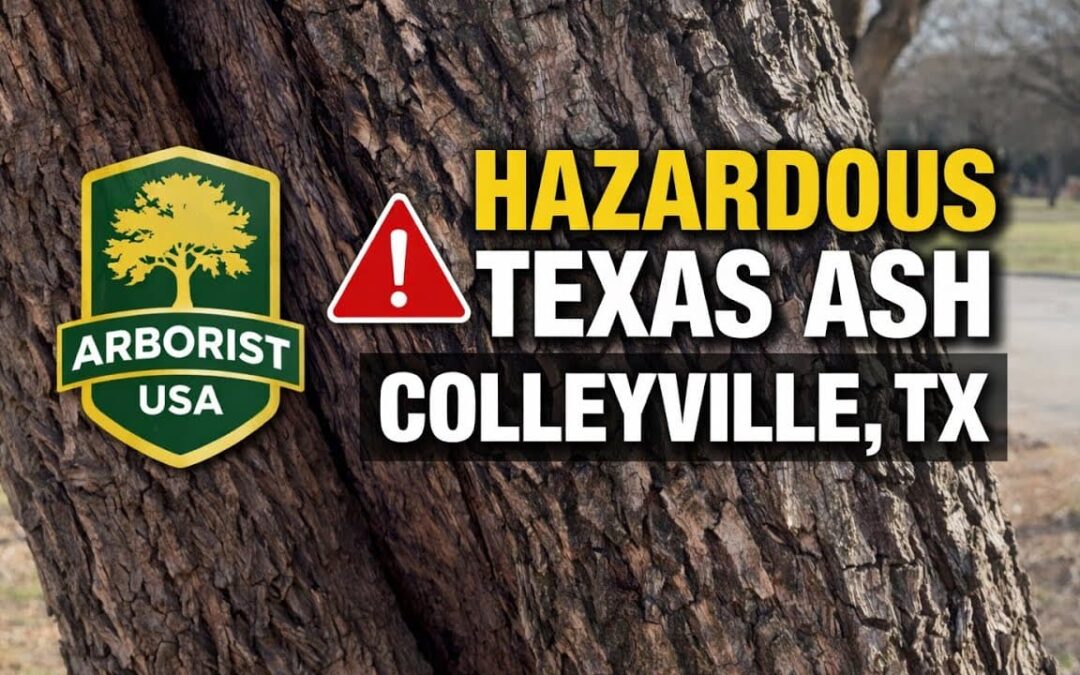
Tree Risk Assessment – Texas Ash in Colleyville, TX
Tree Risk Assessment performed on a mature Texas Ash (Fraxinus texensis) located at a public park off Bedford Road in Colleyville, Texas. The site contains heavy pedestrian traffic, including frequent occupancy by children, increasing the consequence of failure.
This evaluation follows ISA TRAQ methodology and ANSI A300 standards for structural assessment and risk classification.
Site Inspection & Primary Basal Wound
The first structural defect observed was a significant basal wound measuring approximately 6 feet in length by 2 feet in width on the main trunk.
This wound represents the primary failure point of the tree.
Using CODIT principles (Compartmentalization of Decay in Trees), we evaluate how the tree attempts to wall off injury through four defensive boundaries:
- Wall 1 – Plugging vertical xylem vessels
- Wall 2 – Limiting inward spread
- Wall 3 – Limiting lateral spread
- Wall 4 – Formation of new woundwood (callus)
In this case:
Walls 1 through 3 have completely failed internally. Decay has progressed through the xylem faster than the tree could effectively compartmentalize.
Wall 4 (woundwood formation) is present and visibly sealing the exterior wound margins; however, internal decay is extensive.
The tree exhibits an approximate 30-degree lean. This increases bending stress and torsional load on compromised basal fibers.
Likelihood of Failure: Moderate to High
Impact Zone: High (public park, pedestrian traffic)
Consequence of Failure: Severe (children, public occupancy)
Because this is a high-occupancy target area, the risk level elevates significantly under the ISA risk matrix.
Secondary Structural Failure – Scaffold Union Compromise
A second major defect was identified at the first scaffold branch union. This appears to have originated from windstorm breakage or possible lightning strike.
At this location:
- Walls 1 through 3 have failed
- Vertical decay extends approximately 4 feet up the main stem
- Internal xylem deterioration measured at approximately 25% loss
This defect compromises the primary load-bearing union.
Biomechanical Load & Torque Analysis
The canopy weight distribution leans toward the south side of the drip line. This places torsional stress directly on the compromised union.
Based on canopy mass and stem diameter, the estimated load stress at this junction is approximately 26,000 pounds distributed across two stems meeting at a structurally weakened point.
This creates:
- Increased shear stress
- Lever-arm amplification
- Reduced fiber strength
- Elevated risk of sudden catastrophic failure
Likelihood of Failure: High to Imminent
Impact Zone: High
Consequence: Severe (bodily injury, property damage)
Under ISA TRAQ standards, this combination places the tree in the High to Extreme Risk category.
Overall Risk Rating
Based on:
- Advanced internal decay
- Structural lean
- Scaffold union compromise
- Significant torque load
- High pedestrian occupancy
- Presence of children in park environment
The tree presents a High to Imminent Failure Risk with Severe Consequence potential.
Failure could result in:
- Bodily injury
- Fatality
- Property damage
- Municipal liability exposure
Public safety risk is unacceptable under these conditions.
Professional Recommendation
Removal is strongly recommended.
The tree should be:
- Cut to ground level
- Stump ground
- All protruding surface roots mitigated
- Debris hauled off site
Removal eliminates the hazard and mitigates liability exposure in a high-impact public environment.
This recommendation aligns with ISA best management practices, ANSI A300 structural considerations, and standard municipal risk mitigation protocols.
Final Determination
This Texas Ash is structurally compromised beyond reasonable mitigation.
Given:
- Basal structural decay
- Failed compartmentalization
- Scaffold union weakness
- Significant torsional loading
- High public occupancy
The tree should be removed to mitigate risk.
Public safety outweighs preservation in this case.
For general tree-care best practices, homeowners can also reference guidance from the Texas A&M Forest Service, https://tfsweb.tamu.edu/trees/, a trusted authority on Texas tree health.
Schedule a professional inspection. Early detection and scientific intervention are the difference between preservation and loss. If you’d like to speak to an arborist, please call us at 817-880-6130 or visit https://www.arboristusa.com/
Hello Community, Henry Friar here, ISA Certified Arborist with Arborist USA. In this video, we’re documenting a formal Tree Risk Assessment performed on a mature Texas Ash located at a public park off Bedford Road in Colleyville, Texas.